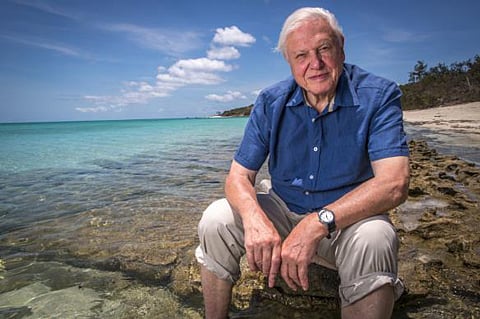


This month we commemorate the hundredth birthday of Sir David Attenborough. We are not merely celebrating a broadcaster, a writer, or a natural historian, but celebrating the way of seeing the world. For many of us, Sir David did not simply teach us about beautiful and exotic plants and animals or take us to places we have only imagined. He taught us how to look at life with patience, curiosity, humility, and wonder.
My early childhood in the 1970s was spent in Africa. Still untouched by modernity, yet the ravages of war and famine knocked on its door. This was also a time when early television programming still carried a certain magic. There were only a handful of programmes that truly transported you beyond the walls and into other worlds. For me, one of those portals was Zoo Quest. Somewhere in those grainy broadcasts, often dubbed in Arabic or French, we caught bits of Sir David’s voice at the end of overlapping sentences. He spoke of wild spaces with creatures never filmed before with a quiet excitement and exhilaration. Such impossible creatures and landscapes, narrated by a soft-spoken and impeccable Englishman spoke directly to every child, sitting cross-legged with their eye wide open before the television. The occasional faux pas and mishaps were never edited out. Their inclusion only deepened the humour and brought warmth and humanity of the episodes.
What struck me even then was that Sir David never behaved like a conqueror of nature. He did not stand above the wilderness. He wasn’t there, like many European explorers before him, to behave like a master or a collector. He traversed forests and grasslands, waded rivers and ponds, and entered caves almost apologetically. Like a guest fortunate enough to have been invited. His style was avuncular, warm, and deeply human. He spoke to audiences not as pupils in need of instruction, but as companions beside him on a trail. One felt that he was discovering these creatures at precisely the same moment we were.
That quality and sincerity of his wonder made him unlike any other broadcaster, or even a safari guide. So many of them flaunt their expertise but Sir David embodied astonishment. Whether observing a bird-of-paradise in New Guinea, a gorilla in Rwanda, or a tiny insect hidden beneath bark, his voice carried the unmistakable tremor of someone still amazed that such beings existed at all. And because he remained capable of wonder, so did we.
In my teenage years, I rediscovered Sir David through his books. Those lavish BBC volumes, filled with glorious photographs and elegant prose, became treasured companions. They did not merely document wildlife; they enlarged the imagination. They suggested that the world was still immense, mysterious, and gloriously unfinished.
Then, in the late 1980s and early 1990s, came the era of pirated video cassettes in Bombay (Mumbai today). Like so many young people hungry for the wider world, I devoured them. Bombay in those years had a thriving trade in VHS tapes of dubious origin. Sometimes we found tapes at the British Council Library, but most times not. Through an informal network of video cassette exchange, I found Sir David’s tapes. The quality was sometimes terrible. Even so I watched Sir David’s series over and over again, replaying episodes until the narration became almost liturgical in my memory. Those tapes were my gateway to jungles, deserts, oceans, and mountains I would never visit, but only imagined.
I hold Sir David entirely accountable for the fact that once I stopped watching the tapes or put down his books, I would walk into a park or even a moss-lined wall with snails, flatworms and millipedes and began to look; really look; at the wildlife in my backyard. It was he who made many of us step outdoors and search for our own animals. His voice gently cajoled us that wilderness was not some distant abstraction that lay in the Amazon or Serengeti, but something waiting quietly in our own backyards. A bird on a branch, a lizard beneath a stone, the movement of insects after rain. Sir David taught us that discovery begins not with travel, but with attention. He made many like me into naturalists. This is what Sir David did. Like a pied piper, his voice playing in our heads, at scale, for generations. He sent us outside, made us curious and made us look. That may be his greatest legacy.
Even here Sir David was different. Unlike other famous broadcasters and naturalist-celebrities he did not classify, dominate, over-dramatise or exploit. Sir David invited us instead to belong to it. His words and voice wove into the emotional fabric of people’s lives across continents and generations. His voice became inseparable from the sound of rainforests, oceans, migration, or the birdsong at dawn. He showed us a dreaming octopus, the dance of birds of paradise, and songs of the whales. He has taken us to places we will never go and made us feel the loss of places that are already gone.
And yet he never preached with rancour or bitterness. Even in his recent works, when his warnings about climate change and extinction grew more urgent, he retained that same quiet decency. He helped transform conservation from a scientific concern into a moral and emotional one. Through his voice, millions came to understand that every obliterated forest, every poisoned river, every vanishing species represented not simply data lost but wonder diminished. He trusted that if people could truly see and feel the living world, they would learn to love it. And if they loved it, perhaps they would fight to preserve it.
Sir David made the natural world feel universal. It belonged to every child, in every continent and in every circumstance. Each child who watched him felt equally invited into the great adventure of life on Earth. That invitation changed lives. Many scientists, conservationists, filmmakers, and explorers today began as children listening to that familiar voice. Some entered forests carrying binoculars because of him. Some became marine biologists because of him. Some simply learned to walk more slowly and look more carefully because of him. These are not small achievements. They represent a transformation in human consciousness. The legacy he leaves behind is one of curiosity without arrogance, knowledge without vanity, and wonder without end.
On behalf of a boy who grew up watching Zoo Quest under an African sky, and a young man who watched pirated tapes in Bombay, and every person in every country who ever sat in the dark and felt the hairs rise on their arms because of a voice and an image and a moment of pure, shared wonder — thank you, Sir David. Thank you for a hundred years of showing us what this world truly is. May we be worthy of it.\
Sir David Frederick Attenborough 8 May 1926 — forever
Pranay Lal is a natural history writer who is currently working on a book on how nature shaped the subcontinent’s history
