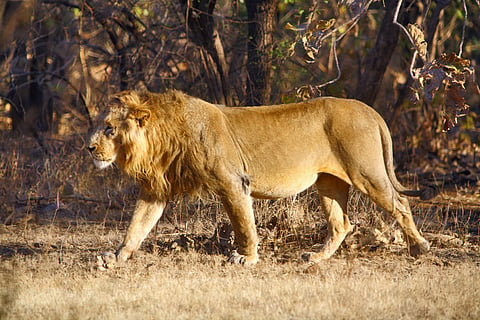


Eight Asiatic lions have died, and 17 others have been infected by an outbreak of Babesia disease in the past few days in the Gir forest, the species’ last refuge in Gujarat.
Babesia disease or Babesiosis is a tick-borne disease caused by protozoan parasites of the genus Babesia. It causes flu-like symptoms and can lead to severe illness. The parasite’s destruction of red blood cells can lead to life-threatening complications, especially if the lions have a weakened immune system.
Weakness, fever, coughing and nasal discharge are among the symptoms in infected animals.
Stotra Chakrabarti, professor of animal behavior, Macalester College and graduate faculty University of Minnesota working on Asiatic and African lions for over a decade said while these losses are concerning, it is important to place them in context. “Most of the reported fatalities appear to be cubs, and our long-term data show that lion cubs under one year of age typically have a survival rate of around 50 per cent," he said.
“Based on the information currently available, the reported number of deaths is not likely to have a significant impact on the overall lion population,” he added.
Chakrabarti added that the area where the current cases have been reported has a high degree of interaction between lions and domestic livestock, making this a plausible route of transmission if babesiosis is ultimately confirmed.
Ravi Chellam, CEO, Metastring Foundation and Coordinator, Biodiversity Collaborative said since this is a vector-borne and non-infectious disease (carried by ticks, with the infection passed on only when the tick carries the parasitic bites to other animals), the chances of it spreading like an infectious disease is much lesser.
“Having said that, since lions are social cats and interact a lot, it is quite possible for ticks from one lion to move onto others, thereby helping spread the parasite. It is known that canine distemper and babesiosis act in tandem and this leads to high and rapid deaths of the infected lions,” he said.
In 2018, 11 lions died due to the Canine Distemper Virus (CDV) disease.
Chakrabarti said babesiosis is frequently discussed alongside CDV because of the well-known 1994 outbreak in the Serengeti, during which the combination of the two diseases contributed to the deaths of nearly one-third of the lion population.
“In that case, lions weakened by babesiosis—associated with heavy tick infestations linked to buffalo—became more vulnerable to CDV, a viral disease that affects the respiratory, gastrointestinal, and nervous systems. The interaction between the two pathogens significantly increased mortality,” he added.
According to the latest census conducted in 2025, Gujarat is home to 891 Asiatic lions spread across Gir Somnath and its adjoining 11 districts.
Chief Wildlife Warden and Principal Chief Conservator of Forests Jaipal Singh told Down To Earth that no deaths or new infections have been reported among the population since May 28.
“The infection is common among the population and had occurred in 2025 as well when around 10-11 lions died,” he said adding that every year during this time, the temperatures are extreme and are accompanied by humidity.
Chellam said deaths due to diseases is always a major worry when it occurs in endangered species, more so when all the surviving wild individuals of a species are restricted to a single population, which is the case with Asiatic lions.
Singh said that the ticks mainly come from cattle and move to lions. “Last year, instances were reported in the Shetrunji division and due care was taken to contain the disease. However, this year the disease was unexpectedly reported on the western border of the Gir Somnath and Amreli districts that houses nearly 50 lions,” he added.
The officer explained that ticks are blood suckers and feed on haemoglobin. If levels reduce, leading to pneumonia, the situation becomes fatal for the animal.
He said monitoring is key to controlling the disease and the recovery rate is good.
“At present, 17 lions are under special care. They are receiving blood transfusions to maintain blood levels. Personnel are on standby to provide drips and antibiotics and also perform deworming if needed,” he said.
Singh said last year, a 1.5-year-old cub successfully recovered after blood transfusion.
According to the census, 394 lions reside within protected areas including the Gir National Park, Gir Wildlife Sanctuary and Pania Wildlife Sanctuary. Most of the remaining 497 lions occupy lands outside core areas — the Barda Wildlife Sanctuary, coastal Bhavnagar, and other non-forested zones.
Since the outbreak of the disease, the Gujarat forest department has intensified disease-control measures in and around the Gir landscape.
Singh said lions suspected to have the disease have been isolated and authorities are engaged in deworming and tick-removing.
Chellam underlined the need for Asiatic lions to have a second home.
“The translocation of lions from Gir to Kuno ‘in letter and spirit within 6 months’ was ordered by the Supreme Court of India on April 15, 2013. By not implementing this order of the Supreme Court, the state Government of Gujarat and the Government of India are acting with impunity and endangering Asiatic lions,” he said.
He added that translocation of lions to establish additional and geographically isolated free-ranging populations of wild lions is a science-based and logical conservation action to ensure that the conservation success with Asiatic lions endures well into the future. It will effectively mitigate a wide range of extinction risks, he said.
Chakrabarti added that one factor working in Gir’s favour is that the lion population is relatively well dispersed across the broader landscape, which can provide some protection against the rapid spread of infectious diseases. Unlike highly concentrated populations, a more distributed population structure can help limit transmission and reduce the likelihood of a disease affecting all individuals simultaneously.
“The question of establishing a second free-ranging population of Asiatic lions is a more complex issue. While there are strong scientific arguments in favour of creating an additional population as a safeguard against disease outbreaks, natural disasters, and other unforeseen threats, the ultimate decision extends beyond science alone. Conservation outcomes are shaped by a range of stakeholders, policy considerations, and political processes. As with all conservation questions, the answer is based on socio-political factors,” Stotra concluded.
Meena Venkatraman, a researcher who has studied the species, said that scientists and field biologists wih long experience should be included in conservation conversations.
