
Subscribe

Extreme heat due to climate change and land use change threatens to wipe out nearly 8,000 species of vertebrates including amphibians, birds, mammals and reptiles, a new study has found.
The paper, published in the journal Global Change Biology, assessed how future extreme heat events under different scenarios of thermal limits can potentially impact almost 30,000 species.
Under the worst-case scenario, 8,000 species are estimated to face unsuitable conditions across 52 per cent of their range.
“By the end of the century, up to 7,895 species are expected to face extreme heat events and/or unsuitable land use changes across their entire range, and thus potentially go globally extinct,” the analysis said.
The authors studied scenarios including SSP1-RCP2.6, SSP2-RCP4.5, SSP3-RCP7.0, and SSP5-RCP8.5 that are combined climate scenarios linking future societal paths (SSPs) with radiative forcing levels (RCPs) to project different climate futures.
The scenarios range from SSP1-RCP2.6 (sustainable, low warming) to fossil-fuelled development or business as usual with high warming and emissions at SSP5-RCP8.5. They show varied impacts on temperature, food security, and urban areas.
SSP2-RCP4.5 is the middle ground scenario, while SSP3-RCP7.0 is the regional conflict scenario.
The study found that climate change and land use change would make many species vulnerable, exposing them to unsuitable conditions especially for amphibians and reptiles by 2100.
About 12.4 per cent of the species would be exposed to heat events in the low warming sustainable scenarios. In the high emission levels scenario, unsuitable conditions pushed by extreme heat events and land use changes would turn almost 52.4 per cent of species’ suitable habitat areas out of reach compared to the same time frame in 2015.
The study noted that under SSP3-RCP7.0 (regional conflict scenario), land use changes may cause profound area unsuitability that is compounded by the impacts of extreme heat events far more than in other scenarios.
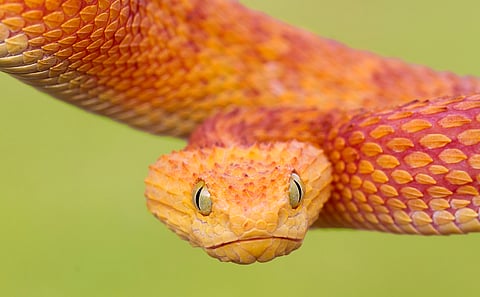
For example, under SSP3- RCP7.0, the African bush viper (Atheris broadleyi), is expected to lose 81 per cent of its 2015 suitable area due to land use changes and 76 per cent due to extreme heat events by 2100.
Birds, mammals, and reptiles are expected to face decreases in their suitable area of 10 per cent, 13 per cent and 11 per cent respectively compared to their suitable areas in 2015 which is 4-6 times higher than under SSP2- RCP4.5 or SSP5- RCP8.5 (1 per cent to 3 per cent). Amphibians will face this exposure in almost 13 per cent of their suitable habitat, twice as much as under the SSP5- RCP8.5 scenario, the study pointed out.
It said, “Under all future scenarios, amphibians and reptiles are expected to be more exposed to unsuitable conditions across their ranges than birds and mammals.”
Even under the most optimistic scenario of low warming, amphibians and reptiles are expected to face unsuitable conditions, on average, in over 23 per cent and 13 per cent of their 2015 ranges, respectively, due to the combined effects of extreme heat events and land use changes, compared to less than 2 per cent and 4 per cent for birds and mammals, respectively, it said.
These greater effects on amphibians and reptiles may also be related to their relatively smaller range sizes as exposure to unsuitable conditions by 2100 was significantly higher for species with smaller initial range sizes, for amphibians and reptiles, and for species with higher International Union for Conservation of Nature threat categories, it added.
“The synergistic impact of climate and land use changes is most noticeable in the Sahel — Sudan, Chad and Mali, the Middle East — Afghanistan, Iraq and Saudi Arabia, and Brazil,” the study said.
In worst case scenario, most species will face unsuitable climate conditions in vast areas across Brazil, Bolivia and Paraguay, North Africa, the Middle East, India and Western Australia.
The scientists warned that additional stressors such as interspecific interactions, other climate extreme events (wildfires, droughts), and anthropogenic pressures (novel pathogens and zoonotic diseases, chemical and light pollution, invasive species), can interact with extreme heat events and land use changes in complex ways. Though not considered in the analysis, they can further exacerbate biodiversity loss.
