

It is time to celebrate the magic of sparrows again on yet another World Sparrow Day. There have been concerns that the little birds have been disappearing of late from human settlements. Which would be a great tragedy as perhaps no other bird has been as deeply entwined in human life as the sparrow.
This World Sparrow Day, Down To Earth examined the role of the sparrow in the Sikh tradition of the northwest Indian subcontinent. Sikhism developed in the Punjab region and as such most Sikhs are ethnic Punjabis. Consequently, the landscape where the faith was born also made its way into its teachings.
In the abstract to her paper Sparrows and Lions: Fauna in Sikh Imagery, Symbolism and Ethics (2013), Eleanor Nesbitt of University of Warwick writes that, “Given that the Sikhs’ scriptures — the utterances of their Gurus — are works of poetry, this article majors on the daily presence of insects, birds, fish and mammals in the recitation of the image-rich poesy that makes up the Guru Granth Sahib. Appreciation of this imagery requires understanding of the rural Punjabi context and also of earlier Indic compositions, whether sacred or secular.”
The sparrow thus features along with various other fauna and flora in Sikh writings. Yet, it has carved its own unique distinct space.
The sparrow is most commonly associated with the tenth Sikh Guru, Gobind Singh. One of the first instances comes when he quite young.
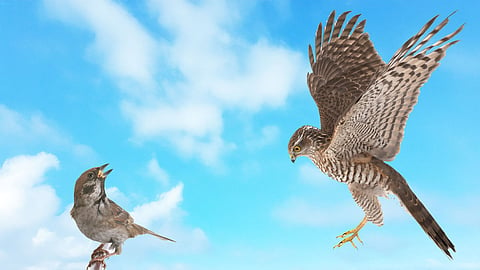
Nesbitt narrates: “Birds and animals repeatedly feature in Gurū Gobind Singh’s life. For example, foreshadowing the 1699 event, the Gobindpurā gurdwārā commemorates an occurrence when the eight-year-old Gobind summoned two nearby sparrows to attack the falcon of a Pīr [Sufi worthy] who coveted his own falcon. In Sikh tradition this was the occasion for Gurū Gobind Singh’s words: ‘It is when I make sparrows fight hawks that I am called Gobind Singh.’”
The most important instance of the sparrow in Guru Gobind Singh’s life comes during the formation of the Khalsa brotherhood in 1699 Common Era.
“Central to Sikh tradition is an event in 1699 which is usually referred to as the founding of the Khālsā. On the day of the annual Vaisākhī (Spring harvest) festival, Gurū Gobind Singh, the tenth Gurū, rallied his followers in Anandpur (in the state of Punjab) and loudly called for the head of a Sikh. (The Punjabi word sikh means ‘disciple,’ ‘learner’.) When five volunteers had in turn come forward — and had apparently each been beheaded in his tent — the Gurū brought them out intact for ritual initiation with amrit, water that his wife had sweetened by adding some patāse (sugar sweets). The assembled crowd then saw two sparrows swallow some of this water and immediately attack the Guru’s falcon and put it to flight. Clearly, people realised, the amrit could turn initiates into fearless warriors,” writes Nesbitt.
The sparrow thus became a powerful metaphor in Sikh tradition, symbolising the empowerment of ordinary, downtrodden people—the “sparrows”—transformed into courageous warriors (hawks) by Guru Gobind Singh’s Amrit. This metaphor highlights the Khalsa’s ability to challenge oppressive, superior forces (“hawks”) through divine grace and fearlessness.
There is, however, one other instance of the sparrow in the Guru Granth Sahib which shows a different side of the bird.
The shabad goes like this:
The elephant eats a hundred pounds of ghee and molasses, and five hundred pounds of com. He belches and grunts and scatters dust, and when the breath leaves his body, he regrets it. The blind and arrogant die insane. Submitting to Waheguru, one becomes pleasing to Him. The sparrow eats only half a grain, then it flies through the sky and chirps. The good sparrow is pleasing to the Master, for she chirps the Name of Waheguru.
— Raga Malaar, Vaar Malaar ki Mehla 1, sloak 2, preceding pauri 19, page 1286
Here, the sparrow represents humility, eating only a tiny amount and singing, representing a saintly life unlike the arrogant elephant that destroys its surroundings.
The sparrow thus represents both, humility and innocence as well as transformation to fearlessness due to divine grace.
According to Nesbitt: “Sikh tradition affords creative resources for reconnecting with the environment in the era of a dawning ecumenical attention to ecological distress, whilst at the same time Sikhs, especially in diaspora, are increasingly distanced, culturally and linguistically, from the Gurus’ imagery and from interaction with non-human animals.”
