
Subscribe

At around 9 am on August 27, rain and mist around Thalakkulam near Pooppara in Kerala’s Munnar region concealed a danger that residents of the state’s high ranges have learnt to fear.
S Ochappan, 68, a farmer from Bodinayakanur in neighbouring Tamil Nadu, had gone to his daughter’s cardamom plantation to check whether the crop was ready for harvest when a wild elephant suddenly attacked him. He was taken to the Government Medical College Hospital at nearby Theni but died on the way.
Ochappan’s death has once again brought Munnar and its surrounding high ranges into the centre of Kerala’s worsening human-elephant conflict. It came less than three months after 36-year-old Mari was trampled to death at Chinnakanal on June 8, while her 11-year-old son was injured. A day before Ochappan’s death, another wild tusker entered Munnar town and came close to the Mount Carmel Basilica, sending people scrambling for safety.
The timing of these deaths is significant. A latest study by the Wildlife Institute of India (WII), released in August 2026, provides a disturbing picture of the scale and geography of the conflict. The study, undertaken under Project Elephant, analysed human-elephant conflict in Kerala between 2008 and 2025 and recorded 581 human deaths, 1,200 injuries and 1,781 conflict incidents across the state. The Munnar landscape alone accounted for 103 human deaths, the highest in Kerala.
The study also recorded 695 wild elephant deaths in the state during the same period. Of these, 226 were attributed to human-induced causes. Electrocution alone accounted for 154 deaths and train collisions for 17.
The WII findings point to a deeper problem: conflict is concentrated in landscapes where habitat fragmentation, expanding agriculture and plantations, roads, infrastructure and human habitation increasingly overlap with elephant movement areas.
The question, therefore, is not simply why elephants are attacking people. It is why people and elephants are being forced into the same shrinking spaces with increasing frequency.
Munnar occupies a special place in the Indian imagination. Situated at about 1,600 metres above sea level, it is one of India’s best-known hill stations, drawing visitors from across the country and abroad for its cool climate, tea gardens, mist-covered mountains, waterfalls and forests.
The three mountain streams of Muthirapuzha, Nallathanni and Kundala give the place its name, Munnar, or three rivers. But the Munnar celebrated in tourist brochures is a relatively recent creation.
The region was inhabited by indigenous communities, including the Muthuvans, long before European planters arrived. The hills came to wider colonial attention in the 1870s. In 1877, large tracts were leased to European planters and plantation companies followed.
Coffee, cardamom, cinchona and other crops were tried before tea emerged as the dominant commercial crop. By the end of the 19th century, large tea estates had transformed the hills into one of South India’s major plantation landscapes.
Munnar became a summer retreat for the British. Roads, plantation settlements and commercial infrastructure grew around the tea economy. The old colonial cottages and plantation structures still survive as reminders of that transformation.
Tourism later discovered what the planters had already understood: Munnar’s landscape was extraordinarily valuable.
Eravikulam National Park, the habitat of the endangered Nilgiri tahr, Anamudi, the highest peak in South India, Mattupetty, Kundala, Top Station, Chinnar and the shola forests around Munnar have turned the wider region into a year-round tourism circuit. The flowering of the Neelakurinji, which transforms parts of the hills into a carpet of blue once every 12 years, has added another layer to its fame.
“The contradiction is now stark. The same landscape is simultaneously a tourist destination, a plantation economy, a network of settlements and roads, and an important wildlife habitat. And elephants are caught in the middle,” says conservation activist M N Jayachandran.
No discussion of Munnar’s changing relationship with elephants can avoid the animals that have acquired names, personalities and almost celebrity status.
Arikomban became a national symbol of human-elephant conflict after repeatedly entering houses, shops and ration stores in Chinnakanal in search of rice. He was captured in April 2023, radio-collared and moved to the Periyar landscape.
He later crossed into Tamil Nadu, creating another episode of conflict. His story demonstrated one of the central difficulties of translocation: moving an elephant does not necessarily remove the ecological and geographical reasons that brought it into conflict with people in the first place.
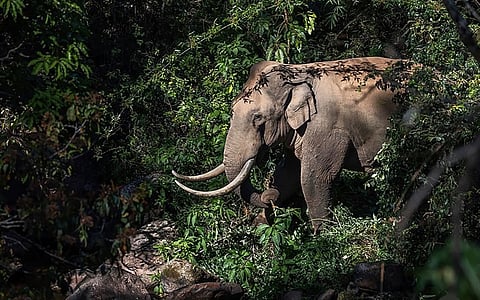
Then there is Padayappa, which has become something of a Munnar celebrity. The tusker is regularly seen around roads, plantations and populated areas. Jackfruit-eating Chakkakompan and other elephants have similarly become familiar figures in the region.
“For tourists, the sight of a large tusker beside a tea estate or road can be an unforgettable wildlife experience. Videos of elephants stopping traffic or walking through Munnar routinely circulate on social media. For plantation workers and local residents, however, the same animal represents something altogether different,” says M J Babu, who has written two books on Munnar’s history.
“A tourist may stop a vehicle to photograph an elephant. A worker may have to decide whether it is safe to walk home. This distinction exposes a dangerous romanticisation of wildlife. Elephants are neither villains nor tourist attractions. They are wild animals navigating a landscape increasingly altered by humans,” he says.
The Munnar elephant crisis has deep roots in land-use change. Elephants move across the high ranges between forests, plantations and adjoining landscapes, following routes remembered over generations. They move between feeding grounds, water sources and seasonal habitats.
They do not recognise the boundaries humans have imposed between forest, plantation, revenue land and private property. Human beings have drawn different lines across the same terrain.
Tea plantations were followed by cardamom plantations, settlements, roads, power infrastructure and tourism facilities. Some settlements emerged through government land distribution and rehabilitation programmes. The 301 Colony at Chinnakanal is one complicated example, where land was distributed to tribal families in an area also identified as elephant habitat.
Over time, human habitation became denser while elephants continued to use the landscape.
It would nevertheless be simplistic to describe every settlement in the region as encroachment. Many residents have legal rights, historical claims and livelihoods tied to the land.
Conservation cannot become a justification for dispossessing poor or indigenous communities. The harder challenge is to prevent further fragmentation while finding humane solutions for settlements already located in high-risk areas.
Munnar’s tourism success has created another layer of pressure. Roads that once served plantation communities now carry large volumes of tourist traffic. Hotels, resorts, homestays, restaurants, shops, parking areas and other commercial establishments have expanded the built-up footprint.
The issue is not tourism itself. Munnar depends heavily on tourism and thousands of families derive their livelihoods from it. The question is whether tourism is expanding according to the ecological capacity of the mountain landscape.
Unregulated construction is particularly dangerous in terrain where forests and wildlife corridors are already fragmented. The history of illegal construction and environmental violations in Munnar has repeatedly brought the region before courts and government agencies.
The pressure is visible on the roads too. Routes passing through elephant landscapes have repeatedly witnessed encounters between vehicles and elephants.
A road may be an essential public facility. But in an elephant corridor, it can also become a wall that moves.
The WII figures make clear that the conflict is not a one-sided story.
During the 18-year period studied, 695 wild elephants died in Kerala. Of these, 226 deaths were attributed to human-induced causes. Electrocution accounted for 154 deaths and train collisions for 17.
These figures show that elephants are also paying a substantial price for a landscape increasingly organised around human requirements.
Agriculture adds another complication. Elephants are attracted to several crops widely grown in Kerala, including banana, coconut, jackfruit, paddy, rubber, coffee, pepper, cardamom, ginger and pineapple.
A plantation next to forest can therefore become an attractive feeding ground.
The answer cannot be to abandon farming. Nor can farmers reasonably be expected to tolerate repeated crop destruction without compensation and protection.
That is why the conflict needs to be treated as a landscape-management problem rather than an elephant-management problem.
In the Thalakkulam incident, an alert had reportedly been issued in the morning about an elephant herd in the area. Heavy rain and dense fog made visibility difficult.
Rapid Response Teams had circulated warnings through mobile messaging systems.
Such systems are essential, particularly during the monsoon when rain, fog and poor visibility can make encounters more dangerous. But a WhatsApp alert cannot substitute for landscape planning.
Plantation workers may not see messages while working. Elderly farmers may not use smartphones. Visitors may have no knowledge of local warnings.
Early-warning systems need to reach people physically and reliably through sirens, local volunteers, watchtowers, patrols and rapid-response teams.
At the same time, elephant corridors need legal and physical protection. Existing barriers must be examined. Roads need wildlife-sensitive crossings and speed controls. Electric fencing must be designed to protect people without becoming another source of elephant mortality.
High-risk settlements may require long-term rehabilitation plans, but such measures must be carried out with dignity, adequate compensation and livelihood support.
“The tragedy at Thalakkulam should not become an argument for removing elephants from Munnar. Nor should it be used to dismiss the fear of people who live and work there,” says Babu.
Residents have a legitimate right to safety. Elephants have an ecological need to move through a landscape that existed long before roads, plantations, hotels and property boundaries.
The answer lies somewhere beyond the familiar cycle of an elephant attack, public outrage, capture, translocation and temporary relief.
The latest WII study makes the larger lesson difficult to ignore. Munnar is not merely a hotspot because it has a large elephant population or because a few elephants have become accustomed to human habitation. Conflict has become concentrated because multiple forms of human land use have converged on a landscape through which elephants have continued to move.
Munnar therefore needs landscape-level planning that brings forests, plantations, settlements, roads, tourism and wildlife corridors into a single framework.