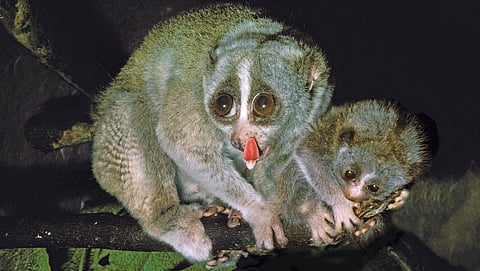


The grey slender loris is a unique primate found in southern India and Sri Lanka.
It faces threats from hunting and habitat loss despite its ecological importance.
Conservation efforts are underway to protect it by restoring habitats and promoting awareness to reverse harmful mythical beliefs.
When you hear the name “grey slender loris”, your mind might leap to the flamboyant King Julien from the 2005 movie Madagascar, or his wide-eyed sidekick Mort. The link is understandable, but misleading: Julien and Mort belong to the lemur family of Madagascar, while the grey slender loris is a very different primate found only in southern India and Sri Lanka.
Yet this mix-up reveals a fascinating truth — lemurs and lorises, though far apart geographically, may share a common ancestor. Their evolutionary link is even cited as evidence for the continental drift theory, which says that Earth’s landmasses once formed a single supercontinent.
Despite such evident scientific importance, the grey slender loris sees little recognition beyond southern India.
The primate inhabits landscapes from the wet evergreen forests of Wayanad to the dry scrublands in Tamil Nadu. In Tamil folklore, the loris is called kaadu paapa or “the child of the forest”, measuring barely 25 cm and weighing less than 400 g. In parts of Kerala, old honey collectors believed the loris’ cry would indicate rain.
Some villages believed hearing its call before harvest warned of an imminent storm or crop pest attack. The call is deemed special because it is never unintentional; being a nocturnal hunter of crickets, grasshoppers, lizards and small birds, the loris moves in stealthy silence. While it has no tail, its flexible spine and long limbs help it cross the canopy with agility, and opposable thumbs allow it to cling motionless for long periods.
The animal has large, forward-facing eyes with extraordinary night vision. Kerala’s Kattunaikkan and Kurumba communities speak of it as a night being with large glowing eyes that never makes unnecessary noise and watches paths hidden by thick creepers. The Muthuvan tribe in the hills along the Kerala-Tamil Nadu border warns children to not follow the loris at night as it can lure them into thorny areas where snakes rest.
Some tribal groups state the loris knows which plants ease pain or heal wounds as it feeds on insects that live only on certain medicinal shrubs. Fact is, the loris helps control insect populations and even consumes toxic insects by licking mild venom secreted from glands near its elbows before hunting — a rare adaptation among primates.
Some beliefs, however, cause harm. The primate has long been hunted for body parts falsely believed to cure eye ailments and ward off evil. It is also captured for illegal pet trade and roadside shows in Tamil Nadu and Karnataka. Its numbers further decline due to road kills, electrocution and unregulated tourism breaking canopy continuity.
Population estimates are primarily available only through local studies. For example, a 2022 study by the Sálim Ali Centre for Ornithology and Natural History, Coimbatore and the Tamil Nadu Forest Department estimates over 8,800 individuals in Karur and 8,400 in Dindigul. The loris is protected under Schedule I of the Wild Life (Protection) Act, 1972, and listed Near Threatened by the International Union for Conservation of Nature (IUCN).
Kerala and Tamil Nadu have begun efforts to restore habitats and strengthen monitoring. In Kadavur Reserve Forest in Tamil Nadu, forest watchers are mapping canopy corridors and planting native trees. Conservationists also call for introduction of nocturnal wildlife surveys, stricter law enforcement and awareness programmes that revive folklore-based protection of the species.
This article was originally published as part of the December 16-31, 2025 print edition of Down To Earth