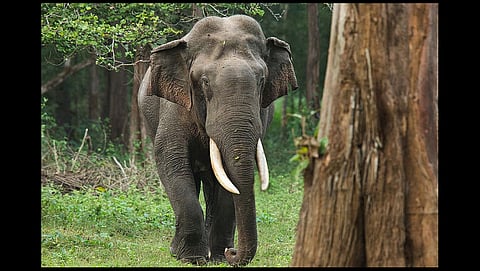


World Elephant Day has been celebrated globally since 2012. But why was it launched? What triggered this movement? Since its inception, are we still glossing over the oversimplified rhetoric of “care” and “love”, or are we engaging with the systemic crisis wild and captive elephant populations face to survive?
Most importantly, how do elephants persist in a world where the human gaze, often wrapped in love and care, is riddled with contradictions? A world exceedingly influenced by both changing spatial and digital realities?
Elephants are among the few mammals celebrated across Asia for many reasons. They are worshipped, hold cultural importance, and are deeply entwined in history, traditional folklore, and pop culture across religions. For thousands of years, they have also been captured for labour: in war, timber extraction, construction, religious and ceremonial work, and tourism. Let’s not forget the colonised elephants, considered valuable to the empire and forced to support Western colonial exploits in Asia and Africa. They were used as gifts and continue to be privately owned as symbols of status.
Asian captive elephants continue to be assets, commodified for capital and entertainment. Come 2026, elephants continue to navigate a world of shared spaces dominated by humans and their love for dichotomies.
While we talk about saving wild elephants, we continue to hand over their homes and the natural resources they depend on to corporations. While we stress the need for habitat connectivity and restoration, we also approve mining, hydroelectric, and linear infrastructure projects across the same landscapes.
If we are awed by a “wild” elephant in the forest, some of us are just as excited to see the same elephant years later working as a tamed animal, carrying heavy loads and leading a festival procession. While we pile on negative adjectives for a wild elephant involved in interactions, the same individual becomes a hero and saviour when it leads religious events or helps capture other wild elephants.
We call locals sharing space with elephant encroachers without realising their cooperation sustains a large wildlife population. While we remove locals from tiger reserves, we have no problem with overtourism there. While we demand forest departments patrol and safeguard forests 24/7, we don’t provide enough pay or support to thousands of forest guards.
Animals of their size, with irrefutable memories persisting more frequently today in human-dominated landscapes, unfortunately often stand out, despite their aversion to self-exposure. As human-elephant interactions rise across India, state institutions often arrest and fine farmers for harming elephants, yet the same institutions also capture wild elephants, often without confirming their involvement in conflicts and train them to help capture more wild elephants. We continue to build and expand ‘elephant rescue centres’ to keep more wild elephants in captivity.
We forget that mahouts originated from the need to domesticate wild elephants forcefully, establish dominance over them, and make them work for humans. This tradition, often upheld by a majority, also contests Western views on captivity. Yet struggles to face the realities of these captive elephants still used to keep many of the same colonial practices alive. Today, mahouts are often celebrated when their trained kumkis help capture wild elephants or when their tusker leads the Dasara processions. Paradoxically, the tradition faces a deep crisis across Asia due to an ageing workforce and lack of well-trained mahouts. Yet growing short-term conservation efforts pushed by the state, its institutions, and traditional religious organisations have increased the demand for mahouts due to the rise in elephant camps, rescue centres, and festival pageants.
World Elephant Day was conceived by Canadian filmmakers and a member of an elephant reintroduction nonprofit in Thailand. The movement was inspired by the condition of captive elephants in Thailand and the need to end their exploitation. It also advocated for their reintroduction to the wild. Today, the movement has grown to raise awareness about the condition of elephants, both wild and captive, worldwide.
Come 2026, the irony is unmistakable:
Recent research shows that elephant tourism venues in Thailand, India, Laos, Cambodia, Nepal, Sri Lanka, and Malaysia continue to maintain large elephant populations, with Thailand still having the highest numbers.
According to a 2018 IUCN report, just over 100 captive elephants in Thailand have been reintroduced to the wild.
Captive elephants now also include a growing number of wild elephants captured as a primary response to increasing human-elephant interactions across Asian countries.
India now has a growing number of rehabilitation centres, many of which are struggling to accommodate the increasing number of wild elephants due to limited space and a shortage of trained mahouts.
Talking about contradictions, I offer more in this context:
This year, World Elephant Day national celebrations will be held at Visakhapatnam. The same city that has been witnessing protests against the construction of a Google AI data centre, managed by Google’s subsidiary Raiden Infotech along with Adani Infra. It poses a big threat to natural resources and will displace locals and wildlife.
The same state has seen more frequent encounters between people and elephants, a recent change after a few elephants moved from Odisha, where mining has displaced wildlife for decades. To manage this, the state, like many others, has unfortunately also resorted to using kumkis and setting up elephant camps and rescue centres.
In 2018, the state forest department launched ‘Operation Gaja’ to push a herd of elephants back to Odisha, but it failed. Telangana has similarly tried to drive elephants back to Maharashtra. One tusker, ME-3, was repeatedly forced between three states in this way, just like how his peer, Omkar, all of just 10 years-old, was being pushed between Goa, Maharashtra and Karnataka. Forcibly driving elephants from one state to another is now common too.
This month (August 1-6) alone, 9 people have died in human-elephant encounters, 1 elephant has been killed, 3 cases of ivory seizures across states have occurred, and dozens of interaction incidents have been reported.
Across the country, elephants are moving into new areas, including elevations as high as 3,266 metres, to sustain their populations. Despite their well-documented intelligence, strong social bonds, and commendable adaptive skills, their future remains uncertain in a landscape increasingly shaped by conservation actors and supporters riddled with contradictions.
While the “DAY” celebrations will echo loudly in urban cities and digital feeds, two primary actors — the locals sharing space with wild elephants and the elephants themselves will largely remain in the shadows, as always.
In the last 14 years, World Elephant Day has mostly helped state governments, institutions, non-profits, and support groups achieve their public relations goals. Meanwhile, the fate of wild and captive elephants remains tangled in a web of complexities and unpredictability, shaped by human motivations and emotions: love, hate, helplessness, sympathy, reverence, greed, fear, pride, adoration, meanness and more…
Gana Kedlaya is an independent journalist based in Bengaluru
Views expressed are the author’s own and don’t necessarily reflect those of Down To Earth
