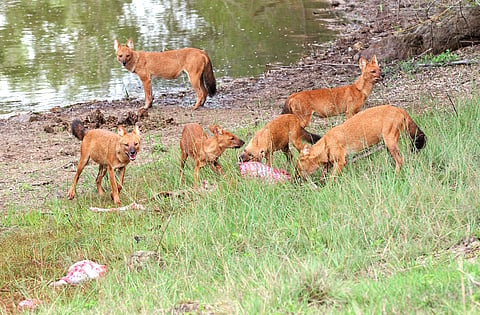


Dholes, those ‘hypercarnivore’ (over 70 per cent of their diet consists of meat) canids of Asia, mostly eat sambar and chital and very little livestock at least in Central India, if a recent study is to be believed.
The paper titled Minimal Sample, Maximum Insight: DNA Metabarcoding Uncovers the Diet of Endangered Dholes in Central India by Abhinav Tyagi, Alex M., Prajakta Hushangabadkar, Nandkishor Kale, Jitendra Ramgaokar and Uma Ramakrishnan, was published in May in the journal Environmental DNA.
Dholes (Cuon alpinus) or Asiatic wild dogs, are among the most threatened carnivores globally and are currently listed as Endangered by the International Union for Conservation of Nature.
“Endemic to South and Southeast Asia, dholes have suffered a substantial range contraction of over 80% from their historical distribution. In India alone, dholes have lost nearly 60 per cent of their range over the past century. Nevertheless, India still supports the largest remaining dhole population in the world,” notes the paper.
Within India, three primary metapopulations persist in the Western Ghats, Central India, and Northeast India.
According to the authors, the forests of Central India and the Western Ghats harbour relatively high dhole densities, largely due to the extent of protected habitat and the availability of wild prey.
These canids are social carnivores and live in packs. They play a crucial role in maintaining ecosystem structure and function by regulating prey populations. “Ensuring sufficient prey availability is critical for dhole conservation, as their hypercarnivorous diet imposes high energetic demands,” adds the paper.
While earlier studies examining the diets of dholes across their range have mostly relied on traditional approaches such as direct observations or micro-histological analyses, the authors of the current paper decided to do something different.
They applied DNA metabarcoding to investigate dhole diet. The paper stated that the study describes “the widest dietary breadth recorded for the species to date, comprising 15 prey species. This represents an important methodological advancement in understanding the trophic ecology of dholes.”
The researchers determined the overall diet of dholes in the Tadoba Andhari Tiger Reserve, a key stronghold for the species in central India, using 169 samples collected across two seasons.
“In total, we recovered 15 unique vertebrate prey species. Based on frequency of occurrence (FOO), the most commonly detected species was chital (Axis axis; FOO = 0.704), followed by sambar (Rusa unicolor; 0.669), barking deer (Muntiacus muntjak; 0.556), black-naped hare (Lepus nigricollis; 0.308), wild boar (Sus scrofa; 0.266), and four-horned antelope (Tetracerus quadricornis; 0.112),” according to the paper.
The remaining nine species had FOO values below 10 per cent.
“Relative read abundance (RRA) values followed a broadly similar pattern, with chital (0.331), sambar (0.259), black-naped hare (0.145), wild boar (0.108), barking deer (0.051), and four-horned antelope (0.051) comprising the majority of dietary reads. RRA values for all other taxa were below 1%. We found very low proportions of domestic prey species in the dhole diet based on both FOO (cattle: 0.065; buffalo: 0.077) and RRA (cattle: 0.008; buffalo: 0.003). Some unexpected species were also identified, including Asian palm civet (Paradoxurus hermaphroditus), small Indian civet (Viverricula indica), and rusty spotted cat (Prionailurus rubiginosus),” they noted.
The scientists did not detect significant consumption of other large-bodied herbivores such as gaur (B. gaurus) and nilgai (B. tragocamelus), despite their known presence in the landscape and earlier reports of their occurrence in dhole diet. “This pattern may reflect prey preferences or constraints linked to prey vulnerability or pack hunting strategies.”
Dhole diet varied across the two seasons that the researchers studied them: winter and the (summer) monsoon. Dholes ate 15 species during the monsoon and feasted on 11 during the winter.
“During winter, chital and sambar were the dominant prey species, whereas in the monsoon, the diet was more diverse and no single prey species dominated. Along with large ungulates, species like wild boar and Indian hare formed a substantial portion of the diet. This could reflect the increased availability of smaller-bodied prey or the difficulty of hunting large hoofed prey such as sambar and chital during the monsoon, when dense vegetation and waterlogged terrain may hamper dhole hunting efficiency. Similar patterns have been observed in African wild dogs, where feeding behavior shifts occur in response to prey densities, with smaller prey becoming dominant with decreasing large prey availability,” the authors said.
Interestingly, dhole diet was more variable in the core compared to the buffer zones. This, according to the researchers, may be driven by lower wild prey densities in buffer areas combined with dholes’ apparent avoidance of domestic livestock.
“In buffer areas, we did observe higher occurrences of four-horned antelope and nilgai, this likely reflects prey availability rather than a preference for these species. Our findings also revealed occasional predation on other taxa such as civets, rodents, langurs, and birds.”
Importantly, domestic species such as cattle, buffalo, and goats were rarely detected in dhole diet by the scientists, unlike in other co-occurring large carnivores such as tigers and leopards.
“In our study, livestock consumption was negligible, further supporting the idea that high wild prey densities can reduce the likelihood of negative human–carnivore interactions.”
They did detect a small number of occurrences of domestic species like cattle and buffalo in dhole scats. “This is likely due to scavenging behavior, as dholes have been observed feeding on kills made by tigers or leopards,” said the researchers.
In conclusion, the author noted that their findings emphasise the importance of conserving prey-rich habitats beyond protected areas to support dhole persistence in multiple-use landscapes, where prey depletion and competition with sympatric carnivores such as leopards may otherwise constrain dhole distribution and abundance.
