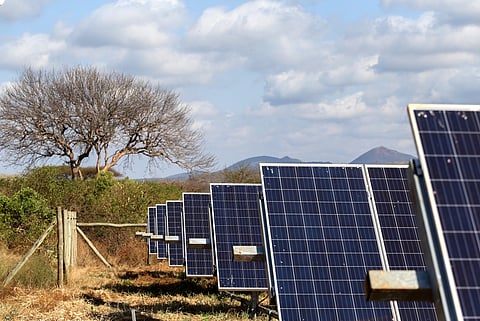


Battery-backed solar mini-grids could help expand electricity access in rural and remote parts of West Africa, where conventional grid extension is often too costly, IRENA said.
Western Africa accounted for 33% of the 565 million people without electricity in Sub-Saharan Africa in 2023, with most living in rural and remote communities.
Solar mini-grids with battery storage represent a near-term opportunity of about 568MW across Burkina Faso, Mali, Nigeria and Senegal, potentially serving 21 million people.
IRENA said falling solar and battery costs, stronger policies and innovative finance could make mini-grids central to expanding access and reducing reliance on diesel fuel.
Battery storage could help solar-powered mini-grids deliver reliable and affordable electricity to rural and remote communities in West Africa, where conventional grid expansion is often too costly, according to a new report by the International Renewable Energy Agency (IRENA).
The report, Unlocking Battery Storage Potential for Sustainable Mini-grid Electrification in West Africa, examines the role of solar photovoltaic mini-grids combined with battery storage in Burkina Faso, Mali, Nigeria and Senegal.
Western Africa is the second-largest subregion in Sub-Saharan Africa in terms of people without electricity, accounting for 33 per cent of the 565 million people without access in 2023, IRENA said. Most live in rural and remote areas where extending conventional grids is often not economically viable. Across rural Sub-Saharan Africa, 451 million people were still without electricity in 2023.
To address this, IRENA has developed its Strategic Energy Access Planning Support programme, which helps countries use data-driven, least-cost planning for rural electrification. The analysis found that decentralised renewable energy systems can offer an increasingly competitive alternative where conventional grid expansion faces technical or financial limits.
According to the report, solar mini-grids with battery storage represent a near-term market opportunity of about 568 megawatts across the four countries, covering around 42,700 settlements and serving about 21 million people.
Nigeria represents the largest opportunity, requiring nearly 400 megawatt (MW) of mini-grid capacity, followed by Burkina Faso with 91.7 MW, Mali with 56.3 MW and Senegal with 20.3 MW.
The potential becomes much larger when conventional grid expansion is constrained. Under such scenarios, mini-grids with battery storage could supply more than half of new electricity connections, serving between 47 million and 110 million people.
Battery systems can store electricity generated during periods of strong solar availability and supply it when solar resources are limited. This helps balance supply and demand and improves the reliability of solar mini-grids.
The economic benefits could also be substantial. Under the highest-demand scenario, battery storage could generate nearly $25 billion in value, requiring about 130 gigawatt hours of battery capacity.
IRENA said storage can reduce reliance on diesel generators and protect consumers from volatile fuel prices. It estimated that avoided fuel costs could outweigh the additional investment in battery storage by two to four times, strengthening the case for hybrid solar-battery systems.
By 2030, nearly 2.25 gigawatt-hour (GWh) of battery storage could be needed across the four countries to deliver universal supply at Tier 2 demand levels, the report said.
Around 397,270 settlements across Burkina Faso, Mali, Nigeria and Senegal could potentially be served by mini-grids. Solar PV is suitable for 98.5 per cent of them, or 391,480 settlements.
The IRENA report stressed that universal access will require unprecedented deployment, alongside stronger policies, technical skills, regulatory standards and innovative financing. Blended finance and de-risking mechanisms will be particularly important for attracting investment and scaling up solar-battery mini-grids.
The findings showed that falling solar and battery costs could make battery-backed mini-grids a central pillar of West Africa’s efforts to expand electricity access, improve energy security and reduce reliance on costly diesel fuel.
