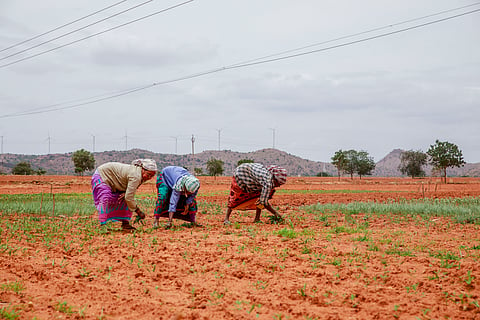


Kharif sowing across India is 20% behind last year’s level after a weak start to the southwest monsoon delayed planting in several states.
About 35 million hectares have been planted so far, compared with 44.3 million hectares during the same period last year.
June rainfall was 40% below normal, making it India’s fifth-driest June in a century, according to IMD data.
The agriculture ministry has flagged 111 districts as high-risk because they face prolonged rainfall deficits and have irrigation coverage below 25%.
Kharif sowing across India is running about 20 per cent behind last year’s levels, after a weak start to the southwest monsoon delayed planting in several major agricultural states. Sowing has lagged across nearly all major crop categories, with rice, pulses, coarse cereals, oilseeds and cotton all behind last year's levels.
At least 20 days after sowing began in most parts of the country in mid-June, planting has only covered about 35 million hectares (mha), down from 44.3 mha during the same period last year, according to figures released by the Union Ministry of Agriculture and Farmers Welfare.
The slowdown is being driven by a rainfall deficit across key agricultural regions. June rainfall was 40 per cent below normal, making it India’s fifth-driest June in a century, according to India Meteorological Department (IMD) data.
The dry spell has coincided with strengthening El Niño conditions over the equatorial Pacific, a weather pattern usually associated with weaker Indian monsoons. The IMD expects El Niño conditions to persist through the June-September monsoon season, raising doubts over whether July will bring enough rain to close the gap.
June is the first month of sowing for the kharif season. But in recent years, a dry June is becoming a persistent problem for farmers who have been skipping the month and shifting sowing operations towards July.
The ministry’s data show the extent of the slowdown. Rice, one of the most important kharif crops, has seen its sown area fall by 0.9 mha from last year, to 6 mha.
Pulses have also declined, with sown area falling from 4.7 mha a year earlier to 3.7 mha this year. The steepest decline has been in oilseeds. The area under oilseeds has fallen by nearly 40 per cent, from 10.9 mha in 2025 to 6.6 mha this year.
This shortfall is also damaging for India’s missions on pulses and oilseeds, designed to reduce the country’s dependence on imports of these two crop categories.
India’s agriculture remains heavily dependent on the southwest monsoon. The kharif season, which overlaps with the monsoon, accounts for roughly half of India’s annual foodgrain production.
About 55 per cent to 60 per cent of the country’s net sown area is rainfed, meaning it depends largely on rainfall and has limited irrigation backup.
With 2026 being an El Niño year, the agriculture ministry has identified 111 districts as high-risk and high-priority. These districts face two overlapping vulnerabilities: a weak monsoon outlook and irrigation coverage below 25 per cent. This means farmers have little to fall back on if the rain does not come.
A majority of these districts are located across 12 states: Madhya Pradesh, Maharashtra, Gujarat, Uttar Pradesh, Rajasthan, Karnataka, Bihar, Jharkhand, Telangana, Andhra Pradesh and Odisha.
Scientists have warned that this year’s El Niño is on track to be among the strongest ever recorded, often being referred to as a ‘super’ El Niño event.
During an El Niño event, the surface waters in the central and eastern Pacific Ocean become significantly warmer than usual and that interacts with trade winds which weaken and disrupt global weather patterns, triggering extreme climate events like droughts.