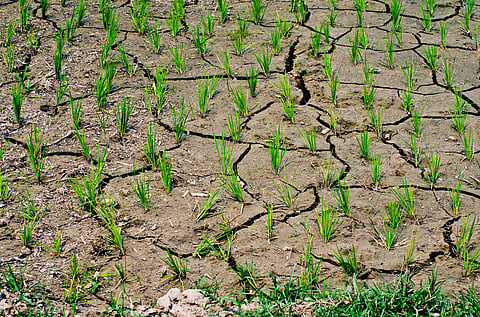


El Niño has arrived, with forecasts warning of a growing chance of a “super” El Niño later this year.
FAO says India is among the countries most exposed to agricultural drought, with rainfed crops such as rice and maize at risk during the kharif season.
Large parts of India have already recorded deficient rainfall in the early weeks of the southwest monsoon.
India has identified 196 priority districts as officials assess crop risks, farmer alternatives and possible import needs.
El Niño has arrived, and with forecasts warning of a growing chance of a “super” El Niño later this year, India is among the countries most exposed to agricultural drought, according to a new analysis by the Food and Agriculture Organization of the United Nations.
This isn’t like previous El Niños — the planet is warmer, conflict and food insecurity are widespread, and the places most at risk have the least capacity to cope.
The warning comes during India’s kharif planting season, when crops such as rice and maize depend heavily on the southwest monsoon. El Niño can weaken the summer monsoon across much of India, putting rainfed crops under stress during a critical growing period, the FAO said.
Between June 1 and 22, half of India had received deficient rainfall (-20% to -59% below the expected normal), while nearly a quarter had recorded large deficient rainfall (-60% to -99% less than the expected normal), according to the categories used by the India Meteorological Department (IMD).
The FAO analysis, based on 41 years of satellite data from its Agricultural Stress Index System, identifies a broad belt of elevated drought risk across Asia — from Pakistan and India through Myanmar, Thailand, Cambodia and Vietnam, and further east to the Philippines, Indonesia and Timor-Leste.
South and Southeast Asia is one of four high-risk regions identified globally, along with the Sahel, southern Africa and Central America.
El Niño is the warmer-than-normal phase of the El Niño Southern Oscillation phenomenon in the equatorial Pacific Ocean. It occurs when trade winds weaken, allowing sea surface temperatures in the central and eastern Pacific to rise. The unusually warm temperatures can alter rainfall patterns through evaporation, moisture build-up and rainfall in the eastern and central Pacific Ocean, while suppressing rainfall over Australia and the Maritime Continent.
The IMD has said El Niño conditions are present over the equatorial Pacific and are expected to strengthen during the southwest monsoon season. Forecasts from the Monsoon Mission Coupled Forecast System also indicate further strengthening during the monsoon.
The FAO warns that El Niño can put rainfed crops such as rice and maize under stress. South and Southeast Asia is one of four high-risk regions identified globally, alongside the Sahel, Southern Africa and Central America. The stakes for the region extend well beyond food security at home.
Many of the same regions were hit hard during the El Niño events of 2015-16 and 2023-24. In 2015-16 alone, El Niño affected more than 60 million people and prompted $5 billion in humanitarian appeals across 23 countries, the FAO said.
In 2015, when the last very strong El Niño took hold, maize and rice output fell across major Asian producing countries, pushing up prices for key food commodity crops and rippling through global markets.
In India, one of the world’s largest rice producers and exporters, the government is already in a crisis mode and has identified 196 priority districts, where the risk can be the highest. A multi-ministry task force comprising officials from the agriculture ministry, Indian Council Of Agricultural Research, socio-economic planning, and commerce and trade is also preparing a picture of how El Niño will affect major crops, what alternatives farmers can shift to, and from where India can import commodities if domestic supplies fall short.
Other regions where the situation could worsen are the Sahel region, and southern Africa, including Namibia and Botswana, Angola, Zambia, Zimbabwe, South Africa and parts of Mozambique and Madagascar, where the FAO’s forecast points to a greater than 50 per cent probability of agricultural drought.
Currently El Niño conditions are present over the equatorial Pacific Ocean and are expected to strengthen further during the Southwest Monsoon season. Forecasts from the Monsoon Mission Coupled Forecast System (MMCFS) indicate a further strengthening of El Niño conditions during the Southwest Monsoon season.
Scientists also warn that the risks this time are skewed to the upside, as climate extremes increasingly collide with conflict and economic stress. “This isn’t like previous El Niños. The planet is much warmer today, and with conflict and food insecurity widespread, this new phase will hit hardest in places that are already vulnerable and have limited coping capacity,” said Jorge Alvar-Beltrán, FAO Natural Resources Officer.
More than 80 per cent of drought impacts on agriculture are projected to hit in low- and middle-income countries. “A farmer might first lose crops, then livestock, and with that their entire livelihood,” said Alvar-Beltrán. “With cascading impacts of multiple crises already evident, there is an urgent need to act early.”