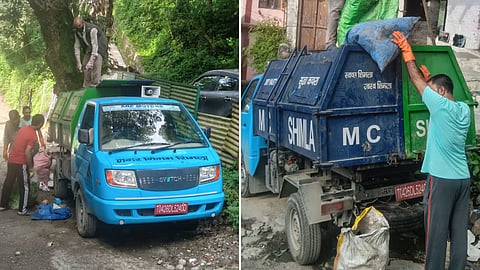


Shimla is testing 12 battery-powered garbage vans on steep, narrow roads as Himachal Pradesh expands its electric mobility policy beyond buses and highways.
The electric waste-collection fleet has been operational since April 2026, but officials say its real test will come in winter, when snow, cold and steep gradients could affect performance.
The state is also linking EV adoption with employment through subsidised e-taxis, with 96 owner-drivers currently attached to government departments.
Himachal Pradesh now plans to introduce 1,000 privately owned electric buses on underserved routes, though charging gaps, delayed payments and vehicle reliability remain concerns.
Every morning in Shimla, 12 battery-powered garbage vans navigate the city’s narrow roads and steep slopes to collect household waste. The vehicles are replacing diesel-powered garbage vans, offering a glimpse of how Himachal Pradesh is extending its electric vehicle policy beyond buses and highways.
The experiment is part of a wider shift in the state’s approach to electric mobility, with the government seeking to link EV adoption with employment and essential public services.
Alongside electric waste-collection vehicles in Shimla, the state is supporting young people to own and operate electric taxis. It has also introduced a scheme to subsidise privately owned electric buses on routes that currently lack bus services.
The move to electrify garbage collection began as a pilot in September 2025, when the Municipal Corporation, Shimla, deployed two electric waste-collection vehicles with support from corporate social responsibility funds. The initiative was supported by ICLEI South Asia.
The fleet has since grown to 12, with joint funding from the state transport department and the municipal corporation. The vehicles have been operational since April 2026.
Shimla generates roughly 90 tonnes of household waste every day, collected by a combined diesel and electric fleet of 60 vehicles, according to Rajneesh Brar, vehicle in-charge and health inspector at the Municipal Corporation.
But using electric vehicles in Shimla is not simply a matter of replacing one vehicle with another. The city’s steep gradients and narrow roads make waste collection demanding, while charging infrastructure remains limited. The first batch of vehicles came from one commercial manufacturer, but those struggled on Shimla’s inclines, so the transport department officials trialled 10 vehicles from another company.
The newer vehicles, with 26 kW power, lighter fabrication material for the waste container, and better maintenance and servicing support, performed better, Varsha Parmar, project officer at ICLEI South Asia, a sustainability network working with the state transport department on electric mobility. The corporation has continued with that model.
Each vehicle can carry close to a tonne of waste and run up to 140 kilometres on a single charge.
The 12 electric vans are a small but growing share of the fleet, which the corporation hopes to expand once the technology has been tested fully on the city’s terrain.
The real test, however, will come in winter, when Shimla’s roads can be covered in snow and temperatures drop sharply.
The vehicles have been operating only since April 2026, so the corporation is yet to assess how their batteries and performance hold up in snow and cold conditions. Steep gradients and narrow roads are already a challenge, and some routes require four-wheel-drive vehicles in winter, which the current electric waste vans do not have.
“The real test is winters. That is when we will understand how the vehicles perform through a full year of mountain conditions before scaling up the fleet,” Brar said.
Charging infrastructure is another constraint. At present, the corporation has one fast-charging point in the city, which can charge one vehicle at a time, and a separate slow-charging facility with four charging points.
Officials say Shimla will need more charging stations across different parts of the city as the electric fleet expands.
The experiment is also beginning to spread to other hill towns. The Municipal Council in Manali has piloted one electric waste-collection vehicle and is now inviting tenders for six more, according to Parmar.
Beyond garbage collection, Himachal Pradesh is using electric mobility to create jobs through subsidies for electric taxis and buses structured as self-employment schemes.
Under the state’s e-taxi scheme, beneficiaries receive a government subsidy to buy an electric taxi. The vehicle is then attached to a government department and driven by the owner, allowing beneficiaries to earn as owner-drivers rather than receiving a one-time purchase subsidy.
Ninety-six such taxis are currently on the road, meaning 96 people have gained employment, according to officials from the labour department, which processes applications for the scheme.
The first phase, launched in 2024, drew more than 400 applications. A second phase, now open, has received around 100 applications so far. The scheme has a budget allocation of Rs 60 crore for the current financial year.
The government provides a 50 per cent subsidy on the cost of the taxi, while the beneficiary owns and drives the vehicle. The taxi is attached to a government department for five years, under an agreement through which the driver receives monthly remuneration.
Depending on the arrangement, the payment ranges from Rs 57,000 to Rs 81,396, a labour department official told Down To Earth.
The model is designed so that earnings over five years help the owner recover the cost of the vehicle, while ownership remains with the beneficiary after the agreement ends, the official said. The government can also extend the arrangement if required.
But one gap in the scheme’s design has already surfaced. Departments using e-taxis were meant to install chargers, but many have not. Drivers now charge wherever they can find a point in the city, often at the Regional Transport Office or municipal parking stations built for Himachal Road Transport Corporation’s electric buses.
For some early beneficiaries, the transition has brought financial challenges.
Harnam Thakur, 39, has been driving an electric taxi since October 2025 — his first EV after years of driving a diesel commercial taxi, which he sold to buy the new vehicle on equated monthly instalments.
The car cost Rs 15 lakh, and his Rs 7.5 lakh subsidy came through on time.
“It’s a good experience,” he said of driving electric.
But the finances have not worked out as he expected.
Thakur is attached to the health department and currently receives around Rs 52,500 as remuneration. He said the amount was revised in March 2026 and, under the new rates, he should receive around Rs 63,000. But the health department, he said, has told him it does not currently have the budget for the higher amount.
With monthly rent in Shimla city of more than Rs 10,000 and an EMI on the vehicle, Thakur said it was difficult to manage on his current income.
His duty usually runs from 9am to 7pm or 8pm, six days a week.
Charging adds another cost and logistical challenge. Since dedicated charging points have not yet been established for many e-taxis, Thakur charges his vehicle at home. His 3.2kW charger takes about 18 to 20 hours to fully charge the 45kWh battery.
Another driver, who did not want to be named, raised concerns about vehicle reliability. He drives a Tata Nexon EV and said he had faced repeated problems with the vehicle’s axle.
He said the axle had already been replaced under warranty, but the problem persisted. According to him, axle-related issues typically emerge at around 70,000km to 80,000km, but he has seen problems at about 10,000km to 15,000km in his vehicle and in some other e-taxis.
The replacement is currently covered under warranty, but the driver said he was worried about repair costs after the warranty expires.
The vehicle performs well on flat stretches, he said, but battery drain accelerates sharply on Himachal’s slopes. On a continuous 100km climb, he estimates the battery loses roughly 1 per cent of charge per kilometre.
“I sometimes keep wondering if I should have stuck with my diesel car,” he said.
The state is now taking its employment-focused EV model further, with a plan to bring 1,000 privately owned electric buses onto Himachal Pradesh’s roads.
Unlike Himachal Road Transport Corporation’s government-owned electric buses, these will be owned and driven by individual beneficiaries under a self-employment scheme, similar to the e-taxi model.
The buses will be 42-seaters, with the government providing a 50 per cent subsidy on the vehicle cost, an official told Down To Earth. Beneficiaries will receive Rs 75,000 a month as an incentive for operating the buses. The arrangement will run for five years, and the owner must also be the driver.
Officials have identified 52 routes where neither HRTC nor private buses currently operate, including routes serving schoolchildren and communities with limited access to public transport.
The routes can extend up to 200km, with preference given to routes close to the beneficiary’s place of residence.
Applicants must be aged between 21 and 45, with preference for lower-income groups. As with taxis, the owner must drive the vehicle. The scheme carries an annual budget of Rs 75 crore.
Despite gaps — inadequate charging points, delayed pay revisions and mechanical teething problems — the schemes have put a working model on the road: nearly 100 drivers earning a living through electric taxis, and electric waste-collection vehicles being tested in one of India’s most challenging urban terrains.
For Himachal Pradesh, where terrain makes transport both essential and difficult, officials say these early experiments could offer a pathway to a cleaner mobility system.