

COP31's draft decision includes a proposal for a dedicated work programme on mountains and climate change, addressing the vulnerability of glacier-dependent communities.
Submitted by Nepal and Bhutan, the agenda aims to strengthen scientific understanding, adaptation, and resilience-building amidst increasing climate-linked disasters in the Himalayas.
Recent disasters underscore the need for transboundary monitoring, early warning systems, and dedicated funding to protect communities and ecosystems from irreversible damage.
A proposal to include measures to gauge the impact of warming in mountain areas has been included in the cover decision of 31st Conference of the Parties to the UN Framework Convention on Climate Change (COP31) currently underway in Antalya, Turkiye. The proposal, submitted jointly by Nepal and Bhutan, comes in the wake of recent spate of climate-linked disasters in Himalayas that have caused record losses and damages.
Point 31 of the draft cover decision text, as on November 16, “Recognizes the particular vulnerability of mountain regions and glacier-dependent communities to the adverse effects of climate change, and decides to establish a dedicated work programme on mountains and climate change to strengthen scientific understanding, adaptation action, resilience-building and support for mountainous and glacier-dependent communities…”. The text further includes a decision to to include a standing agenda item on matters related to mountains and climate change under COP.
The final cover decision will be released at the end of the ongoing summit later this week.
The inclusion of mountain-related agendas comes on the back of a joint submission from Nepal and Bhutan to the COP31 Presidency, negotiators tell Down To Earth (DTE). “We had a meeting with Presidency and shared a joint Nepal-Bhutan submission about the mountain related agendas before COP31 started,” Manjeet Dhakal, a negotiator from Nepal and head of the Least Developed Countries (LDC) support team, told DTE on the sidelines of COP31.
“While few [agendas] have been accommodated in the Presidency discussion involving all parties and the cover decision discussion; others are not accommodated. Unless COP31 responds appropriately to the mountain risk of the region including Nepal, Bhutan and India, it may turn out to be more devastating,” Dhakal said.
The submission, which presents a formal a request to include “1.5 °C Warming in Mountains in the supplementary provisional agenda of COP 31” signed by Geeta Chaudhary, Nepal’s Minister of Agriculture, Forests and Environment, focused on four agenda items:
Advancing scientific understanding of the impacts and risks of 1.5 °C warming and of potential temperature overshoot in mountain regions;
Institutionalising an annual high-level dialogue on mountain and climate change;
Initiate a process towards a dedicated UNFCCC Work Programme on Mountain Ecosystems;
Integrate mountain specific priorities into adaptation frameworks, climate finance arrangements and loss and damage mechanisms
According to sources from Nepal’s negotiating team, the first three agenda items have been addressed and broadly accommodated, and discussions are ongoing for the fourth item. “
Dhakal also emphasised that negotiators are targeting both bilateral and multilateral sources like Global Climate Fund to generate finance for the vulnerable mountain countries.
At COP31, representatives of mountain nations have emphasised in multiple events and meetings that climate change-related impacts are increasing putting the Himalayas under pressure. It it time that the world stop considering disasters as “wake-up calls” and start to “wake up and take action”, they said.
“A series of devastating mountain disasters across the Hindu Kush Himalaya has exposed growing climate risks, gaps in preparedness, and the urgent need for stronger international cooperation, funding and action,” said a statement from the International Centre for Integrated Mountain Development (ICIMOD), an intergovernmental organisation representing the eight Hindu Kush Himalayan countries of Afghanistan, Bangladesh, Bhutan, China, India, Myanmar, Nepal and Pakistan.
"Every time there's a disaster in the Himalayas, we tend to call it a wake-up call … The question before us is: what will it take for us to wake up and take action?" Pema Gyamtsho, ICIMOD’s director general, said during a meeting on November 14, emphasising that recognition without response will not protect Himalayan communities from future disasters.
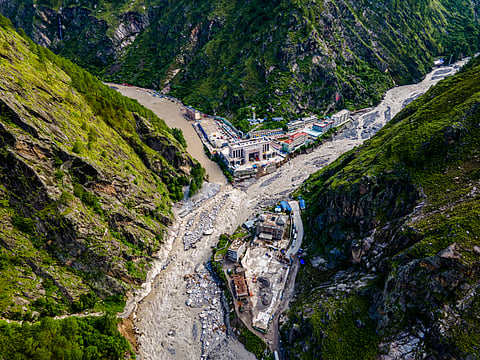
The emphasis on mountain-related agendas comes less than three months after a catastrophic rock-and-ice collapse rocked Nepal. “Nepal estimates it needs over US$4.7 billion dollars to get back on its feet. The Fund to Respond to Loss and Damage last month only approved $21.6 million, funding that will not even be disbursed immediately. Research shows that nearly two-thirds of the international climate finance allocated to Nepal between 2016 and 2023 was in concessional loans, with only about 30 per cent in grants,” according to a statement by the Global Campaign to Demand Climate Justice in early November.
In October, another ice-rock avalanche struck Nepal's Gorkha district, while a glacial lake outburst flood in Bhutan's Shintaphu region damaged roads, bridges and livelihoods downstream.
Also in August, a UN-led global report said that India has recorded the highest glacial flood death toll and the most severe GLOF-related displacement in the Hindu Kush Himalaya (HKH) region.
Several speakers at the ICIMOD highlighted that these are not isolated disasters but signs of a changing mountain risk landscape that threatens communities, infrastructure, water security and economies across the region.
"The Himalayas are often seen as a Shangri-La, a place of peace and meditation … But climate change is affecting us, and that Shangri-La is under threat," said Sonam Tashi, director of the department of environment and climate change in the Bhutan government.
Other representatives pointed out the need for stronger transboundary monitoring, real-time exchange of hazard information, coordinated early warning systems and improved cooperation among countries sharing mountain ecosystems and river basins.
The panel also drew attention to new findings from a recent report by International Cryosphere Climate Initiative (ICCI) and the UN Environment Programme (UNEP), which warns that exceeding 1.5°C of global warming would lead to irreversible losses of snow and ice, increasing the risks of floods, water insecurity and mountain hazards for generations.
