

UN’s Methane Alert and Response System will now cover coalmines and waste facilities
Expansion follows satellite analysis naming an Indian landfill among the world’s top methane emitters
Methane is far more powerful than carbon dioxide in the short term, making rapid cuts key to slowing global heating
The United Nations is expanding its methane monitoring system to cover coal mines and waste facilities, after satellite analysis identified a landfill in India among the world’s three largest methane-emitting sites.
The UN Environment Programme’s International Methane Emissions Observatory (IMEO) announced that its Methane Alert and Response System will be expanded to cover coal mines and waste facilities. The expansion of the system, known as MARS, was announced on May 4, 2026 on the sidelines of a high-level methane event hosted by France under its G7 presidency, according to a UNEP press release.
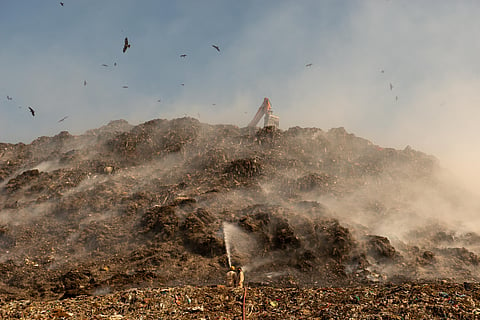
A recent UNEP analysis, published on April 23, 2026, found that coal mining and waste management were major sources of methane emissions around the world. Of the three highest methane emitters identified in the analysis, two were landfills, in Chile and India. The location for the India site correspnds to the Kanjurmarg landfill.
Among the top 50 emitters, 22 were coal mines and 11 were waste facilities or landfills.
A recent satellite-based analysis identified two of the world’s 25 largest methane-emitting landfill sites in India, located in Secunderabad and Mumbai, based on data processed by Carbon Mapper and analysed by UCLA’s Stop Methane Project.
MARS uses data from more than 35 satellites to identify methane “super-emitters”, which are large emissions sources that can be detected from space. It then sends alerts to the countries and industries where these sources are located so that action can be taken. The system also monitors whether the source has been addressed and whether future methane emissions have been mitigated.
Plugging methane leaks could also return about 200 billion cubic metres of gas to global markets annually over time while cutting emissions, the International Energy Agency has said in a new report.
Until now, MARS has focused on oil and gas facilities in countries that are part of UNEP’s Oil and Gas Methane Partnership 2.0, or OGMP 2.0. With the recent addition of national oil companies from Angola, Libya and Pakistan, the partnership is close to covering half of global oil and gas production, according to UNEP.
Methane is more than 80 times more powerful than carbon dioxide as a greenhouse gas over a 20-year period, but it is relatively short-lived in the atmosphere. It breaks down after about a decade, whereas carbon dioxide can remain in the atmosphere for hundreds of years. This makes identifying and reducing methane emissions one of the more immediate ways to cut greenhouse gases.
Since its launch in January 2023, MARS has helped detect and mitigate 41 distinct methane super-emitter sources in 11 countries. The combined emissions from these sources were estimated at 1.2 million tonnes of methane, comparable in climate impact to the annual emissions from nearly 24 million petrol-powered cars, according to UNEP.
Satellites are an efficient way to detect emissions from super-emitters, but they cannot identify all smaller sources of methane, which together make up a significant share of global emissions.
“These sources are just the tip of the iceberg of the world’s methane emissions,” Meghan Demeter, programme manager for MARS, said in the press release. “Satellites shine a light on the big mitigation opportunities, where governments and companies could act first for rapid impact. But real, system-wide progress on methane depends on comprehensive action, including better measurements and reporting.”
Martin Krause, UNEP’s director for climate change, said: “Expanding UNEP’s MARS to coal and waste, strengthening response frameworks, and bringing more companies into verified measurement sends a clear signal: the era of invisible methane emissions is ending.”
Alongside the expansion of MARS, IMEO and the International Energy Agency released a MARS Response Blueprint, which sets out steps for countries to verify emissions, mobilise operators and track mitigation.
IMEO also launched a new Coal Methane Database, which contains mine-level methane emissions data for nearly 250 coalmines, covering more than half of global metallurgical coal production. The database combines satellite observations, scientific research and official inventories. IMEO experts analysed more than 23,000 data points and attributed methane plumes to individual mines.
“Methane cuts are the fastest brake we have on global warming — but only if emissions that are detected are rapidly fixed,” Krause said. “Today’s announcements move the world from knowing where methane is leaking to having the tools to stop it.”