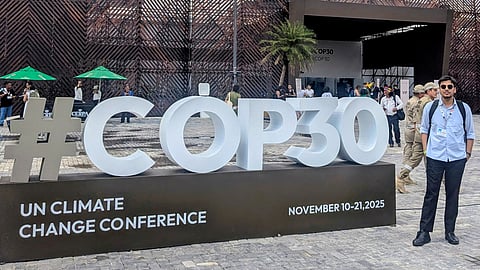


I travelled halfway across the world, from India, to attend the 30th Conference of Parties (COP30) to the United Nations Framework Convention on Climate Change, held in the Amazonian city of Belém, Brazil. This was my first climate COP, and the scale of it is difficult to convey.
The essence of COP lies in bringing over 190 countries together to address the most pressing issues concerning the climate, and then negotiating a collective response to the crisis within a multilateral framework.
Upon my arrival, I found that more than 40,000 people from governments, civil society organisations, Indigenous communities and businesses had descended upon the city. I had followed the negotiations on issues such as the Just Transition over the past year; however, nothing quite prepares you for the opening day of the climate summit: Thousands swarming outside the room where the COP’s agenda was to be agreed upon by participating countries.
My entry point revealed to me how access and hierarchies operate at COPs. The core meetings, such as those determining the conference agenda, saw restrictions for many actors, predominantly those with non-governmental badges.
Beyond these, however, the rest of the conference saw a dissolution of privilege, hierarchies and individual titles: Ministers, negotiators and first-time observers like me waited in the same queues for security clearance or meals.
Following COP29 in Azerbaijan and the Bonn climate meeting earlier this year helped me understand the fault lines that exist in the climate process, most prominently the divide between the developed and the developing world. One could sense the disappointment over the outcome in Baku, referred to as the new collective quantified goal, reflected across negotiations in Belém. Developing countries, led by the Group of 77 coalition (G77) and China, were firm in their stance that climate ambition and the means of implementation must go hand in hand, guided by the principle of common but differentiated responsibilities.
In contrast, the bloc of developed countries led by the European Union (EU) championed the goal of limiting emissions in line with 1.5 degrees Celsius, as outlined in the Paris Agreement. However, from the perspective of many developing country negotiators, this emphasis often appeared disconnected from parallel obligations on finance.
In theory, every country has an equal voice, but in practice, geopolitical context and power dynamics play a decisive role in shaping whose priorities gain traction.
In the absence of large historical polluters such as the United States at this COP, the burden of shouldering financial responsibilities fell on a smaller group of developed countries. The pressure on the EU was evident, as it was more vocal in resisting the demands of developing countries. This was perhaps compounded by its proposed and polarising regulation, the Carbon Border Adjustment Mechanism, which was debated throughout the two weeks in presidential consultations and under the Just Transition Work Programme (JTWP).
As I moved between meeting rooms over the two weeks, it became clear that what dominates COP is not always what is formally on the agenda. For every draft text or proposal, there are proponents and opponents (or blockers), but the degree of attention an issue receives, and the pressure it generates, often depends on the countries involved, the nature of the issue, or the media attention it attracts.
The proposed roadmap on the transition away from fossil fuels illustrates this dynamic. Although not formally included on the COP agenda, the proposal, introduced by Colombia and supported by the Independent Alliance of Latin America and the Caribbean (AILAC), along with several developed countries, received considerable attention in the final days of the conference.
In hindsight, after two weeks of traversing meeting rooms and long walkways, I realised that COP functions as much as an arena of narrative contestation as it does as a negotiating forum. Climate science and political will intersect here, but so do power, perception and influence.
The conference also creates a space for countries to showcase their areas of interest and policymaking approaches to tackling the climate crisis. For instance, a side event at the United Kingdom’s pavilion focused on scaling private finance in clean energy for emerging markets and developing economies, while another side event hosted by Japan promoted carbon capture and storage as a solution to neutralise carbon dioxide emissions.
Such events should be viewed alongside countries’ negotiating positions to understand how pavilions, beyond sharing knowledge, can also shape narratives and serve as tools to influence a wide range of stakeholders.
Side events held by various stakeholders, including UN agencies, non-governmental organisations (NGO)and businesses, further revealed the different entry points and approaches through which they plan to intervene.
While many countries used pavilions to advocate for their causes, observers — including civil society organisations, Indigenous communities, and women- and youth-led NGOs — took to the streets and the waters of Belém to express solidarity with those who bear the brunt of the climate crisis.
Bringing more than 190 countries together to converge on issues related to climate change is a herculean task, especially in the current geopolitical context. However, the negotiations at this year’s COP, through interventions over the two weeks, did hold up a mirror to the lived realities of vulnerable countries.
For example, the African Group demanded that climate finance flow through channels that do not induce debt, given the high cost of borrowing they face, which further drains resources that could otherwise be used for health, education and poverty eradication. Similarly, Like-Minded Developing Countries have elevated the issue of trade over the past year, arguing that protectionism by the Global North, often in the guise of tackling climate change, tends to hinder their own transitions.
My takeaway as an observer is that climate ambition must remain firmly anchored in justice and equity, reflecting real socio-economic constraints, and not merely serve top-down, one-size-fits-all targets. In practice, this means aligning emissions reductions with the development priorities of the Global South, and redefining what success and failure look like for collective ambition and its implementation.