
Subscribe

Budget 2026-27 sharply increases allocations for rural drinking water and sanitation after deep cuts in last year’s revised estimates
Nearly Rs 50,000 crore earmarked for Jal Jeevan Mission works in 2025–26 remained unspent, pointing to delays in implementation
Funding for Swachh Bharat Mission (Gramin) has been restored, with a renewed focus on waste management and sustaining ODF status
Higher grants to states suggest a push to speed up delivery, but questions remain over capacity and pace of execution
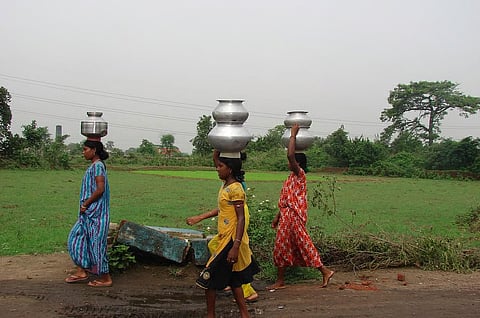
Big announcements for drinking water and sanitation in villages continue to face implementation challenges, despite fresh allocations in the Union Budget for 2026-27.
In the budget estimates for the financial year 2025-26, Rs 66,770.47 crore was allocated for the Jal Jeevan Mission programme component. However, in the revised estimates, this was reduced sharply to Rs 16,944.44 crore.
Central government spending on drinking water and sanitation is expected to rise significantly in the next fiscal year, but the picture is more complex than it appears. The 2026-27 budget figures suggest that, after a year of slow progress, efforts are now underway to push these schemes back into “mission mode”. Whether this will translate into results on the ground remains uncertain.
The most prominent feature of Budget 2026-27, presented in Parliament on February 1, 2026, is the Jal Jeevan Mission, which aims to provide tap water to every rural household.
The programme component — which accounts for the largest share of the mission — covers actual field work such as laying pipelines, developing water sources and providing household tap connections. It is here that the discrepancy in spending is most visible.
For 2025-26, the budget estimate for this component stood at Rs 66,770.47 crore, but the revised estimate reduced it to just Rs 16,944.44 crore. This indicates that nearly Rs 49,826 crore of planned expenditure remained unrealised during the year.
In the budget estimates for 2026-27, the same component has been increased again to Rs 67,363.50 crore. The fluctuation suggests that projects did not progress at the planned pace, and that unfinished physical work and financial liabilities from the previous year have been carried forward. Had implementation stayed on track, such a large cut in the revised estimate would not have been required.
Such underspending typically occurs when proposals from states are delayed, tendering processes stall, or ground-level work progresses more slowly than anticipated.
The budget estimates for 2026-27 therefore imply the need for a major push to revive momentum under the Jal Jeevan Mission. Even within the mission’s overall allocation, the largest shares continue to be earmarked for programme components linked to physical execution, including pipeline laying, source development and household connections.
A comparable pattern is visible in the Swachh Bharat Mission (Gramin), though on a smaller scale. While the budget estimate for 2025-26 was set at Rs 7,192 crore, the revised estimate reduced this to Rs 6,000 crore. For 2026-27, the allocation has been restored to Rs 7,192 crore.
This suggests that, after large-scale toilet construction, the focus is now intended to shift towards solid and liquid waste management, garbage disposal infrastructure and sustaining open defecation-free (ODF) status. However, these activities did not advance as expected during the previous year.
Another key indicator lies in grants to states. While allocations to states were significantly reduced in the revised estimates for 2025-26, they have been raised sharply in the budget estimates for 2026-27.
Revised estimates for state grants last year stood at Rs 18,686.02 crore, compared with a budget estimate of Rs 63,089.97 crore for the current fiscal year. For Union Territories, the provision increased from Rs 678 crore in the revised estimates to Rs 2,156 crore in the new budget.
As water and sanitation schemes are largely implemented through states, this shift suggests that the central government is seeking to accelerate execution by increasing fund flows. The sharp rise in allocations for the north-eastern region also appears to be part of this approach.
Taken together, the figures indicate that the challenge lies not only in announcing funds, but also in the capacity to spend them and the pace of project execution. When budget estimates are set high but revised estimates are cut substantially, it points to disruptions in planning and implementation.
Maintaining similarly high allocations for the following year sends a clear policy signal: the government does not wish to dilute the political and social priority of water and sanitation schemes, even as operational hurdles persist.
On paper, Budget 2026-27 marks a year of significant growth for the sector. In practice, the real test will be whether spending accelerates, states are better prepared, and projects are completed on time. Without improvement on these fronts, the gap between budget estimates and revised estimates could reappear next year.
The central government has stated that steps are being taken to ensure regular and adequate supplies of drinking water of prescribed quality to all rural households. A revised amount of Rs 341.70 crore has been allocated for this scheme in 2025-26.
In addition, a provision of Rs 10 lakh has been made for the PM Janjati Nyay Maha Abhiyan in the budget estimate for 2026-27. Separately, Rs 10 lakh was allocated for the Dharti Aba Janjati Gram Utthan Abhiyan in 2025-26, rising marginally to Rs 11 lakh in 2026-27.
Under the Swachh Bharat Mission (Gramin), the government says it is focusing on expanding sanitation services in rural areas. Having declared villages open defecation-free, the emphasis has shifted to sustaining this status and implementing solid and liquid waste management systems nationwide. The plan also includes a provision to commission the National Payments Corporation of India for research activities.
