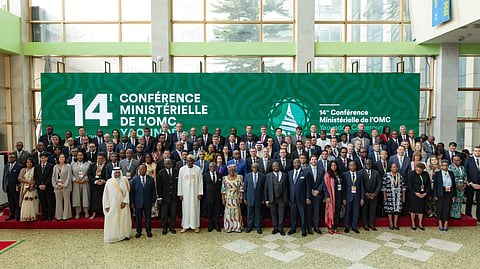


The World Trade Organization’s (World Trade Organization) 14th Ministerial Conference (MC14) opened at the Palais des Congrès, bringing together delegations from 166 member countries.
The opening ceremony set the tone for what is set to be discussed over the course of the conference, with reform of the WTO emerging as one of the key political questions alongside long-standing negotiating tracks.
At a basic level, the push for reform reflects long-standing institutional problems within the World Trade Organization, a paralysed dispute settlement system, repeated deadlocks in decision-making, and broader concerns around transparency and implementation of past decisions. In her opening remarks, Director-General Ngozi Okonjo-Iweala pointed out that the WTO’s rulebook has seen little meaningful update in nearly three decades, noting that this stagnation has contributed to growing tensions and, in some quarters, perceptions of the institution’s declining relevance.
At the same time, the reform debate reflects deeper disagreements over the future of multilateralism within the WTO. This is evident in the submissions and negotiating positions of the United States, which advocate for a more flexible rule-based system, one that may normalise plurilateral arrangements, undermines the consensus-based decision-making process, and, in effect, may well lead to shaking up some of the the foundational principle such as the Most Favoured Nation (MFN) principle. US Trade Representative Jamieson Greer, who is participating in the ministerial, in a video message, cast US trade measures as a “corrective response” to a WTO system he blamed for “severe and sustained imbalances.” In its place, he sketched a “new global trading order” built on “balance and reciprocity”, one that leans on bilateral agreements and smaller groupings of partners.
For many developing countries, this signals a shift away from the WTO’s original multilateral and development-oriented framework. While calling for meaningful reforms, countries such as India have therefore pushed for preserving the consensus-based rule-making system. Leading the Indian delegation, Union Commerce Minister Piyush Goyal cautioned that the “incorporation of plurilateral outcomes into the WTO framework should be based on consensus and should neither impair the rights of non-participating members nor impose additional obligations on them.”
In her speech at the opening plenary, the Director-General noted that, while no one is opposed to a consensus-based system, there is a need to question how it is implemented in practice. Her remarks included references to “coalitions of the willing” and “plurilateral approaches,” perhaps acknowledging that, in practice, the Secretariat is already entertaining a more fragmented and plurilateral future.
To take these discussions forward, the ministerial has organised dedicated breakout sessions on March 26-27, structured around four themes:
- foundational principles of the WTO,
- decision-making and past mandates,
- development, and
- level-playing field issues.
These sessions will be facilitated by New Zealand, United Kingdom, Republic of Korea, Singapore, Costa Rica, and Norway.
Beyond the reform track, negotiations on specific issues — including dispute settlement reform, agriculture, investment facilitation, the e-commerce moratorium, and fisheries subsidies — are scheduled for March 28 in dedicated sessions facilitated by Pakistan, Cameroon, Philippines, Nigeria, and Jamaica.
The ministerial is set to conclude on March 29.
Running alongside the official negotiations, the International Institute for Sustainable Development is hosting a Trade and Sustainability Hub, where parallel discussions are focusing on trade and environment, climate, industrial policy, and clean technology trade — issues that are increasingly intersecting with the WTO’s core agenda.