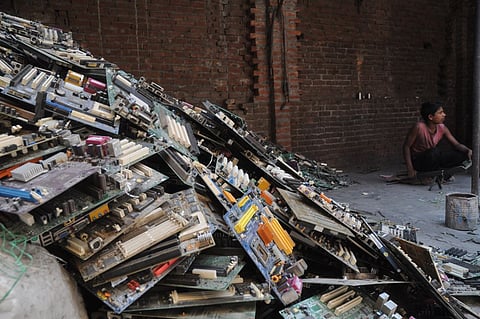

Electronic waste (e-waste) is the fastest-growing stream of waste globally.
The world produced around 53.6 million tonnes of e-waste in 2019, out of which only 17.4 per cent was recycled, a recent report by the United Nations (2020) found. The agency even termed this phenomenon a ‘tsunami of e-waste’.
The global e-waste monitor reported that India, with a population of around 1.38 billion, generated 3,230 kilotonnes (KT) of e-waste, out of which only 30 KT of e-waste was formally collected in 2019.
India generated around 2.4 kilograms of e-waste per capita; only 1 per cent of e-waste was formally collected. The informal sector of waste collection dominates over the formal sector, which is still in its infancy.
It should be noted here that while India’s per-capita generation is among the lowest in the world, the country is the third-largest generator of e-waste in the world.
The facts are disturbing. The responsibility of managing e-waste in India lies with the Central Pollution Control Board (CPCB) and State Pollution Control Boards (SPCB). The authorities were recently summoned by the principal bench of National Green Tribunal (NGT), when the latter took cognizance of unscientific disposal of e-waste in Shailesh Singh v. State of UP.
The NGT asked the authorities to submit a report on the actions taken to manage the e-waste in and around the capital.
Important data on e-waste
The states with the highest number of authorised recyclers / dismantlers are Maharashtra (99), Karnataka (71) and Uttar Pradesh (68). A few states — such as like Arunachal Pradesh, Bihar, Kerala, Manipur, Meghalaya, Nagaland, Sikkim, etc — are yet to establish them.
Action by CPCB so far
CPCB for the first time quantified the generated e-waste in past three FYs: For 2017-18: 708,445 tonnes; for 2018-19, 771,215 tonnes; and for 2019-20, 1,014,961.2 tonnes.
It directed the Uttar Pradesh PCB to take action against dismantlers and recyclers for violating e-waste rules and guidelines.
Shortcomings in e-waste management
What can be done?
Views expressed are the author’s own and don’t necessarily reflect those of Down To Earth
