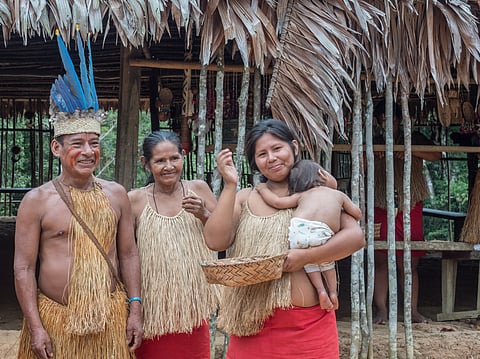


An unconditional basic income of nearly £2 a day was linked to improved food security, living standards and forest conservation among Indigenous communities in the Peruvian Amazon, according to a University of Bath study.
The two-year pilot, supported by climate charity Cool Earth, involved 211 Indigenous participants from three Asháninka and Yanesha communities.
Nearly 90% of participants adopted environmentally beneficial practices, while 87% took part in conservation activities, including reforestation and protecting water sources.
The proportion of households unable to afford nutritious food fell from 73% to 26%, while temporary migration for work declined from 43% to 18%.
Researchers found that direct cash support, combined with community organisation, helped strengthen livelihoods, local leadership and Indigenous communities' ability to manage their ancestral lands.
An unconditional basic income of nearly £2 a day has been associated with improvements in food security, living standards and forest conservation among Indigenous communities in the Peruvian Amazon, according to a two-year study by researchers at the University of Bath.
The pilot programme, supported by climate charity Cool Earth, began in November 2023 and involved 211 Indigenous participants from three Asháninka and Yanesha communities in Peru. The communities have historically faced persistent poverty and challenges in securing their rights and dignity.
Participants received direct cash payments of 1,032 Soles or nearly £2 a day without conditions, alongside support for community organisation and development. The programme aimed to improve economic security while enabling Indigenous communities to manage and protect their ancestral lands.
Researchers from the University of Bath's Universal Basic Income Research Group examined changes in household incomes, livelihoods, community cohesion, education, food security, nutrition and environmental stewardship.
The findings suggest that providing financial security without linking payments to specific conservation activities can help communities improve their livelihoods while strengthening their ability to protect forests.
The study found that nearly 90 per cent of participants adopted practices considered beneficial to the environment, while 87 per cent actively participated in conservation initiatives.
These included planting native trees, reducing forest burning, restoring water sources and improving waste management.
Communities undertook reforestation using native species such as cedar, mahogany and bamboo. They also protected natural springs, constructed organic waste pits and began moving away from clearing forests through burning.
Researchers found that improved financial security enabled more people to remain in their communities rather than migrate temporarily in search of work. The proportion of participants leaving their communities for temporary, often low-paid employment fell from 43 per cent at the beginning of the programme to 18 per cent by its end.
The study suggested that the cash payments allowed families to stay on their ancestral lands and gave households greater flexibility to invest in their land and livelihoods. Around 30 per cent of households expanded their cultivated areas, largely by bringing previously abandoned plots back into use. Some invested in equipment, including motorised weed cutters, while others began growing commercial crops such as coffee and cocoa.
The study recorded substantial improvements in household food security. The proportion of households reporting that they could not afford healthy and nutritious food fell from 73 per cent to 26 per cent. “Likewise, the share of those who had to skip meals decreased from 49 to 22 per cent and of those who felt hungry but did not eat dropped from 51 to 21 per cent,” the study said.
The most severe form of food deprivation — going an entire day without eating — declined from 24 per cent to 15 per cent.
Changes in household diets were also observed, with families moving beyond a heavy reliance on cassava to include more meat, fish, eggs and vegetables.
Training provided alongside the cash payments also supported efforts to strengthen Indigenous food sovereignty. These included establishing community seed banks and cultivating ancestral crops.
The programme was also associated with better standards of living. Nearly 55 per cent of households upgraded their roofs to corrugated metal sheeting, while 51 per cent improved their piped water connections.
Another 26 per cent built toilet facilities, with the proportion of households lacking sanitation falling from 9 per cent to 2 per cent.
Mobile phone ownership reached 95 per cent, while the proportion of households using cleaner gas stoves increased from 23 per cent to 60 per cent.
Around 34 per cent of households acquired solar panels.
Financial security also improved during the programme. The proportion of households reporting savings rose from 49 per cent to 70 per cent, while reliance on emergency loans fell from 19 per cent to 6 per cent.
The study also reported increased engagement with formal financial institutions.
Education was another area of improvement, with 77 per cent of participants reporting that they had contributed towards the education of family members.
Households used the payments to meet costs associated with secondary schooling, transport and university tuition.
The programme was also associated with improvements in community organisation and collective decision-making.
About 85 per cent of participants reported that the pilot had strengthened local leadership and community cohesion, leading to enhanced social bonding and a higher capacity for self-organised community initiatives.
The study concluded that unconditional communal grants demonstrated that community-level funding is effective for territorial defence and collective governance.
“However, in areas where severe economic precarity is causing household-level outmigration, Cool Earth recognised that a complementary mechanism for stabilising family economies is also required,” it said.
Improvements in environmental stewardship did not result simply from paying people to protect forests, the study said. “Instead, environmental outcomes developed through a broader and more fundamentally relational process in which improved economic security, strengthened community organisation, and renewed attention to Indigenous knowledge systems created more favourable social and economic conditions for stewardship,” it stated.
Neil Howard, who leads the University of Bath's Universal Basic Income Research Group, said the programme demonstrated the wider benefits of providing unconditional financial support to historically marginalised communities.
“Giving historically marginalised Indigenous people a no-strings basic income brings a multitude of benefits both to their communities and their environment," he said.
Howard said the payments helped reduce migration for work, alleviate poverty and enable households to plan and invest in their futures.
The ‘Plus’ element of this project, which provided help to communities to organise, also leads to better farming techniques and skills, land use and richer community life and better relationships.
“All of this helps ethical conservation. The incentive to exploit or abandon land is diminished, and people are put front and centre with respect and dignity, which contrasts sharply with the colonial history of conservation and Indigenous policy,” he said.
Sofia Vargas, Cool Earth's Peru Country Manager, said, “Contrary to traditional critiques that basic income creates dependency or reduces work incentives, this first of a kind pilot shows the opposite.”
