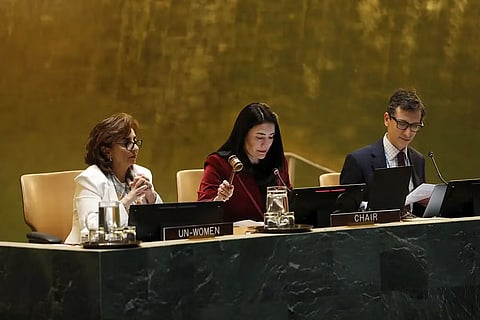


Governments at the UN have agreed a new global framework to improve access to justice for women and girls
The conclusions call for legal reform, stronger protections against violence and wider access to legal aid
The agreement comes as the UN says no country has yet achieved full legal equality between women and men
No country has yet achieved full legal equality between women and men. Now, in a fresh attempt to narrow that gap, governments have now agreed to a new framework intended to make justice more accessible to women and girls worldwide.
The agreement, adopted by broad consensus on March 9, 2026 calls on states to repeal discriminatory laws, expand legal aid, strengthen protections against violence, and make justice systems more accessible and responsive to women and girls.
The conclusions were adopted at the opening of the 70th session of the Commission on the Status of Women (CSW) taking place March 9-19, 2026 in New York, United States. The event brings together governments, civil society groups, and UN agencies to discuss gender equality and women’s rights, and is the UN’s largest annual gathering on the issue.
While the agreement is not legally binding, it is expected to shape national policies and efforts on gender equality in the years ahead, including work tied to the UN’s 2030 sustainable development goals.
UN Women described the outcome, known as the Agreed Conclusions, as a “powerful” commitment to advancing gender equality at a time when women’s rights are facing pressure in many parts of the world.
Sima Bahous, the executive director of UN Women, said the text represented “an important commitment to advancing access to justice for women and girls, ending impunity, and building justice systems that work for everyone, equally”.
The agreement says access to justice is central to equality and non-discrimination, and can help protect women and girls from violence and abuse while strengthening trust in public institutions.
Violence, discrimination and legal inequality still shape the lives of millions of women and girls. Nearly one in three women worldwide have experienced intimate partner or sexual violence, according to a report from the World Health Organization (WHO) and United Nations partners. Nearly 70 per cent of countries maintain discriminatory legal frameworks that prevent women from accessing justice on equal terms
It comes against a sobering backdrop. A recent report by the UN secretary-general found that no country in the world has yet achieved full legal equality between women and men.
The text urges governments to review and amend laws that discriminate against women and girls, including in areas such as child marriage, family law and property rights. It also calls for stronger action to prevent and respond to violence against women and girls, both online and offline, and for better support and faster access to justice for survivors.
Among the measures highlighted in the agreement are commitments to expand legal aid, waive legal fees in some cases, and formally recognise community justice workers and paralegals in national legal systems. It also includes new language on digital justice and the governance of artificial intelligence.
The draft framework stresses the need for what it calls “whole-of-government” approaches, linking police, courts, health systems and social services so that women and girls can access more seamless support. It also calls for more funding for gender-responsive justice systems, including reparation funds for survivors and accessible services for women with disabilities.
In conflict and crisis settings, the conclusions call for justice systems that are gender-responsive and survivor-centred.
Civil society groups and feminist organisations are also given a prominent place in the text. The agreement describes women’s rights organisations as essential partners and calls for the protection of civic space, along with flexible, multi-year funding for such groups.
Maritza Chan, Costa Rica’s ambassador and chair of the Commission on the Status of Women, said the real test would come after the meeting ends.
“We came here to commemorate, and we’re leaving with something harder to carry – responsibility,” she said. “Behind every statistic is a life, behind every negotiating position, is a woman or girl waiting to see if we mean what we say.”
She added: “The answer depends on political will.”
With the session opening amid warnings of a global backlash against women’s rights, UN Women said the agreement should now be turned into concrete action so that women and girls can “live safely, speak freely and exist equally”.