
Subscribe

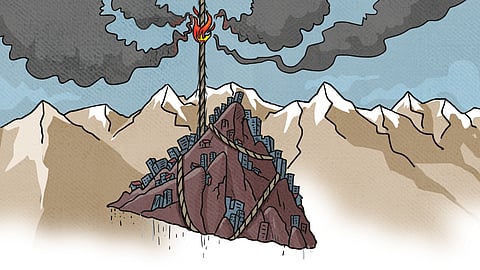
As I write this, over 1,300 lives are confirmed lost and many thousands are still missing in the floods in Nepal, as the mighty Himalayas came down as rubble. This is an enor-mous and painful human tragedy, but it is also about willful actions and inactions of humans. This tragedy is really about our mindset, the be-lief that we, as humans, can re-engineer everything; that we are in control of the universe and all things in it. We are the supreme beings who can weather climate change, because, after all, it is only about a small and insignificant matter of weather. This is on us.
Let me break this down. First, the question of what happened in Nepal on August 26. The images that all of us would have seen are of the mountain coming down—just collapsing—as the flash flood and massive quantity of debris buried everything in its path, taking with it the massive building of the Chinese immigration office. It is a frightening visual, straight out of a science-fiction movie. We know now that this flash flood was not caused by an extreme cloudburst. It was triggered by the collapse of a high-altitude glacier near the Langtang Lirung peak. An estimated 142 million cubic metres of ice and rocks were dislodged, creating a 5.2 magnitude seismic event. This then led to the formation of natural dams, behind which water and moraine accumulated, and when the dams broke, they unleashed even more devastating floods downstream.
Second question is, why? There is no single headline reason, but two events have greatly contributed to this and other such tragedies in this region. One is the well-documented warming caused by climate change. It is literally weakening the Himalayas—the temperature rise melts glac-iers; this, in turn, corrodes the moraine slopes. It is a ticking bomb which implodes as it did in Nepal. In addition, climate change is leading to increased frequency and intensity of extreme weather events, which in turn brings flood and landslide catastrophes, like those seen in Himachal Pradesh in 2025, in Sikkim in 2024 and in Chamoli in 2021. But just so you know, even as I write this and as we watch images of Nepal on our screens, similar floods are happening in different parts of the Himalayas.
We are complicit in this; all of us, but particularly the countries that have contributed the most to the stock of greenhouse emissions in the atmosphere, which, in turn, is driving up temperatures and causing runaway devastations. This is about the past, the present and the future. There is no getting away from the historical responsibility of the richest and most developed countries for this loss of lives. And even as the death toll was rising in Nepal, we got the news that the world was no longer even on an illusionary track to stay below the guardrail of 1.5°C temperature rise since the industrial period of 1870. UNEP estimates that the world will overshoot this threshold within a few years. Scientists know that beyond 1.5°C, the impacts would be cascading and even more devastating—from the collapse of ice sheets to disruptions in ocean currents like the Atlantic Meridional Overtaking Circulation (AMOC), and much more. The intense heat, fires and other weather abnormalities we saw this summer were only a preview of what awaits us. Yet, we seem to be sanguine about this breakdown in our Earth’s system.
Today, we are so distracted by economic and livelihood concerns brought on by deliberate human misdeeds like senseless wars that this enormous and existential crisis seems distant and insignificant. We are merely tinkering with emissions, not transforming it to live within na-ture’s bounds.
Let’s get back to the Himalayas. We know that the climate change ticking bomb is exacerbated by the “nature” of development in these eco-logical hotspots. We talk ad nauseam about adaptation and about how we must take the changing climate into account, but we never do. We really believe that we can continue to do what we do, without consequences. Take for example the hydroelectric projects being constructed by damming narrow rivers. As I have said in the past, and will repeat, this is not about the dam development, but about the recklessness with which they are being developed. In the Indian Himalayas, project after project is coming up—literally back-to-back—so that the Ganga is re-engineered. It will cease to flow naturally, as these projects will regulate its water, taking it to generate electricity and then releasing it back. Then we are tunnelling into the mountains and building roads, often without provision for slope management. I can go on.
But the fact is we are not hearing the message that nature is giving us, loud and clear: change your mindset; your thinking that you can dominate me, bring me to my knees will not work. Change or perish is the message. The question is if we can hear it amid the cacopho-ny of our distractions.
