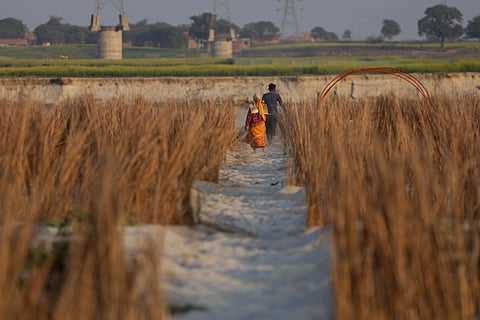


Nearly 30% of 227 monitoring stations across 18 Indian river basins recorded significant declines in baseflow between 1961 and 2021.
Groundwater-fed river flow is declining at several sites in the Ganga and Brahmaputra basins, raising concerns about perennial rivers.
Sabarmati, Cauvery and Pennar basins recorded some of the steepest average declines.
Semi-arid regions are particularly vulnerable, with groundwater extraction and changing rainfall patterns among the possible contributing factors.
Baseflow was significantly lower during El Niño years and periods with longer breaks in monsoon rainfall.
India's perennial rivers are showing signs of declining groundwater contributions, also called baseflow, according to a new study by researchers at the Indian Institute of Technology (IIT) Gandhinagar. This could mean that some rivers and tributaries could become increasingly seasonal.
The study, published in the journal Water Resources Research, found that nearly 30 per cent of 227 monitoring stations across 18 major river basins recorded a statistically significant decline in baseflow between 1961 and 2021. Only about 8 per cent showed a significant increase.
Baseflow is the water that slowly enters rivers from underground reserves, helping them continue flowing after rainfall stops. It is particularly important during dry seasons, sustaining aquatic ecosystems and providing water for drinking and irrigation.
The researchers, Rajesh Singh, Hiren Solanki and Vimal Mishra, found declining baseflow at several monitoring stations in the Ganga and Brahmaputra basins, despite their relatively high dependence on groundwater-fed flows.
They identified groundwater extraction, changes in land use and climatic conditions as possible contributors, although the study did not establish which factors were responsible for declines at individual locations.

The study, titled Observation-Anchored Machine Learning for Baseflow Estimation in India, found declining baseflow trends at almost all monitoring sites in the Ganga basin and several in the Brahmaputra basin.
At many stations in these basins, baseflow accounted for more than 70 per cent of total river flow, highlighting the importance of groundwater in sustaining the rivers.
"The Ganga is a large river, so it continues to flow, but the smaller rivers that flow into it are drying up. Groundwater extraction is a major cause. This is very worrying. Consequently, the future of the rivers is in danger," Mishra told Down To Earth.
The researchers found that the Sabarmati, Cauvery, South Coast and Pennar basins experienced some of the steepest average declines.
In contrast, average baseflow trends were positive in the Brahmani, Godavari, Indus, Subarnarekha and some Northeast Coast basins.
However, trends varied within individual basins, with some monitoring stations recording increases while others showed declines.
Mishra warned that rivers currently flowing throughout the year could become seasonal if groundwater contributions continued to diminish.
"When the monsoon season ends, some rivers continue to flow throughout the season. This means that these rivers remain perennial due to the contribution of baseflow during the dry season," he said.
He identified declining rainfall and excessive groundwater extraction as two possible explanations for rivers drying up during summer.
The researchers used a machine-learning model called Hybrid Gradient Boosting Regressor Baseflow (HyGBR-Baseflow) to estimate groundwater contributions to river flow.
The model combined river discharge, rainfall and soil moisture data with established scientific methods to estimate baseflow, which is difficult to measure directly.
The study also calculated the baseflow index (BFI), which measures the proportion of total river flow contributed by baseflow.
Between 1961 and 2021, the median BFI exceeded 0.6 at monitoring stations in the Ganga, Indus and Brahmaputra basins, indicating that baseflow accounted for more than 60 per cent of river discharge over the study period.
Many westward-flowing rivers along the Konkan coast also recorded values above 0.6.
In contrast, the Godavari, Krishna, Pennar, Tapti and several coastal basins had BFI values below 0.4, suggesting a greater contribution from rainfall-driven runoff.
However, the researchers cautioned that a high baseflow index does not necessarily indicate a secure groundwater supply. Even rivers that depend heavily on baseflow can experience declining contributions over time.
The study divided river basins into three climatic categories: semi-arid, dry-subhumid and humid.
Baseflow declines were most pronounced in semi-arid regions, where the median BFI was 0.38.
These regions generally receive less rainfall and experience greater evaporation, limiting groundwater recharge. Agricultural groundwater extraction can place further pressure on underground reserves.
Humid regions, by comparison, recorded significantly higher baseflow contributions.
The researchers said groundwater depletion, urban expansion, deforestation and dam operations could affect river flows, alongside changes in rainfall and temperature.
However, they stressed that the analysis identified associations rather than establishing direct cause-and-effect relationships.
The study also examined how baseflow varied with major climate patterns, including El Niño and La Niña, which influence India's monsoon rainfall.
Between 1961 and 2021, the average standardised baseflow anomaly was -0.567 during El Niño years, compared with 0.104 during La Niña years and -0.014 under neutral conditions.
The differences were statistically significant, indicating that baseflow tended to be lower during El Niño years and higher during La Niña years.
Researchers also found a significant relationship between breaks in monsoon rainfall and reduced baseflow.
Every five additional monsoon break-days were associated with a 0.231 decline in the standardised baseflow anomaly.
However, delayed monsoon onset and late withdrawal did not show statistically significant relationships with baseflow changes.
The Indian Ocean Dipole, another climate pattern affecting regional rainfall, also showed no statistically significant independent relationship with baseflow anomalies in the analysis.