
Subscribe

In Raika Mala, women spend up to four hours a day fetching water from rain-fed johads shared with livestock
The village, located inside the core zone of Sariska Tiger Reserve, lacks roads, healthcare, electricity and basic civic amenities
Rehabilitation plans under a 2008 policy remain stalled, with most families unwilling to accept cash compensation
Studies show relocated families in the reserve have reported income decline and poor water access at resettlement sites
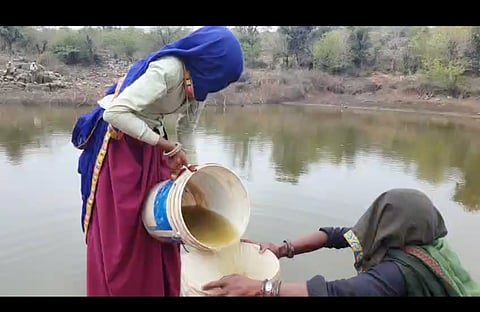
Every day in Raika Mala, women spend hours walking rocky mountain paths to collect murky water from a johad (a small earthen check dam) shared with livestock. For many families in this remote Rajasthan village, access to clean water remains a daily struggle — shaped as much by geography as by conservation policy.
“This is the water that animals and humans drink here,” says 30-year-old Suman Gurjar, straining greenish johad water through a thin white cloth into plastic containers alongside other women. “Even though this water is dirty, it is the only source of sustenance. The entire village depends on it for bathing, cooking and drinking.”
The johad is rain-fed. Thorny bushes cover one side; the others lie open. Animal dung is scattered around the edges. The green tint of the water suggests contamination by the dung.
Suman walks about a kilometre each way along a rocky, uneven path to fetch 20-30 litres of the green and muddy water at a time. Each trip takes 30 to 40 minutes. She makes six or seven trips a day — roughly four hours spent fetching water. Over a year, that amounts to nearly 1,500 hours.
She married into Raika Mala from Kalikhol village in Alwar district. “Where did you get me married?” she recalls telling her parents when she realised how severe the water crisis was. Over time, she says, carrying water without complaint simply became routine.
Every woman in Raika Mala shares a similar burden.
For 40-year-old Urmila Gurjar, the pond lies around one and a half kilometres from home. She walks nearly three kilometres for each round trip, often making seven or eight trips a day. The journey can take up to an hour and a half.
“My head, shoulders and back ache from carrying water all day,” she says. The path also brings the risk of wild animals. When guests visit, she says, the entire day is spent collecting additional water.
The village has about 10 ponds serving both people and livestock. In summer, when these dry up, families migrate with their animals to the plains, around six kilometres away atop the Aravalli mountains, where some relatives live temporarily. With the first monsoon rains, they return.

Raika Mala, now part of Kotputli Behror district after administrative reorganisation in 2023, lies within the Bamanwas Kankar gram panchayat. It used to be a part of the Alwar district before the reorganisation. It is home to around 80 Gujjar families, with a population of more than 600.
The local economy depends largely on animal husbandry. Most families are small or marginal farmers. Some cultivate maize and millet during the kharif season, but many fields lie fallow. Rabi cultivation is largely impossible due to water scarcity.
As a result, the village residents rely heavily on animal husbandry, and nearly every household keeps between eight and 50 buffaloes, which provide their main source of livelihood.
Basic services are scarce. The village has no proper roads, schools, healthcare facilities, electricity or toilets.
To access essential services, village residents must descend a six-kilometre, rocky and dangerous mountain path. The journey can take four to five hours. Vikram Gurjar, who transports goods by motorcycle, calls it “a constant threat of slipping” thanks to the large stones on the route.
“Injuries are common,” he says. Large vehicles cannot use the route, and even riding a motorcycle is risky.
In medical emergencies — particularly during childbirth — women are carried down on a cot by four people. “At times, the cot itself becomes our ambulance,” says Ratanpal Gurjar.
Raika Mala lies within Core Zone 1 of the three zones in Sariska Tiger Reserve. There are 29 villages in the reserve’s core area; Raika Mala is among 11 in Core 1. All core villages are slated for rehabilitation.
The rehabilitation of villages within the core area began after a 2005 report declared the Sariska Tiger Reserve to be tiger-free. The presence of villages in the core area, along with poaching, was blamed for the disappearance of the tigers.
Following this, the National Tiger Conservation Authority (NTCA) was established to conserve tigers and issued a series of guidelines. These included the designation of undisturbed areas within core zones as “critical tiger habitats” to support breeding and ensure sustainable populations. In accordance with these directives, the core area of the Sariska Tiger Reserve was notified as a Critical Tiger Habitat on 28 December 2007 under the Wildlife (Protection) Act, 1972, as amended by the Wildlife (Protection) Amendment Act, 2006.
The Sariska Tiger Reserve spans 1,213.33 square kilometres. Of this, 881.11 sq km has been notified as core or critical tiger habitat, while the buffer zone covers 245.72 sq km of forest land and 86.50 sq km of revenue land.
A rehabilitation policy for villages located in the core area was introduced in 2008. It offers two options to families: a lump-sum payment of Rs 15 lakh, or 6 bighas (around 1.5 hectares) of land along with financial assistance to build a house.
Sariska Field Director Sangram Singh Katiyar told Down To Earth (DTE) that the rehabilitation package is entirely voluntary. There are 29 villages within the core area, of which five — Dabli, Deori, Panidhal, Rotekala and Baghani — have been relocated. The remaining 24, including Raika Mala, are yet to move.
Katiyar said the process has slowed because most village residents prefer land over cash. “Such a large amount of land is not available here,” he says. According to him, meaningful rehabilitation would require 10,000-15,000 hectares, not small fragmented parcels. Many families also want land close to their original homes, which further complicates relocation.
A 2015 study by Murali Lal Meena, published in the journal Space and Culture, described rehabilitation in Sariska as complex and sensitive. Although each family is eligible for Rs 15 lakh, many have shown little interest in cash compensation, fearing loss of livelihood.
The study found that villages in Core Zone 1 had a combined population of about 3,200 people. Around 86.1 per cent belonged to the Gujjar community, with smaller populations of Meena (7.6 per cent), Meo (3.2 per cent), Bawariya (1.7 per cent) and others (1.4 per cent). Traditionally, these pastoral communities depended largely on animal husbandry and the sale of milk and dairy products.
However, the research found that nearly 90 per cent of respondents reported poor water availability at resettlement sites. Before displacement, almost all families were engaged in animal husbandry, with around 14 per cent also involved in agriculture.
After relocation, more than 95 per cent shifted primarily to farming, as livestock-based livelihoods became difficult to sustain. Most respondents reported that their annual income had fallen by over 40 per cent compared to pre-displacement levels, leaving the village economy more vulnerable to drought and food insecurity.
Aman Singh, founder of the Rajasthan-based non-profit Krapavis, told DTE that land remains the primary demand among core-area village residents. “In the absence of land, the government wants people to accept a lump sum and leave. But for many, cash has little meaning without a secure livelihood,” he says.
He alleges that forest officials sometimes pressure families to accept compensation, though village residents continue to resist relocation.
At the same time, Singh says the rehabilitation process is also complicated by local calculations. Some families delay decisions so that younger sons can reach 18 and qualify as separate households eligible for compensation. The prospect of additional land or funds influences how families negotiate the process.
Meanwhile, Pilot Gurjar, a resident of Raika Mala village, told DTE, “We do not want to leave the village under any circumstances. We were born here, and it is also the abode of our deity.” Many families in the village express similar reasons for refusing to relocate.
Jagraon Gurjar adds, “We love our ancestral land above all else. Our village has been inhabited for over 1,000 years. We would not leave it even for crores of rupees, no matter what hardships we face.”