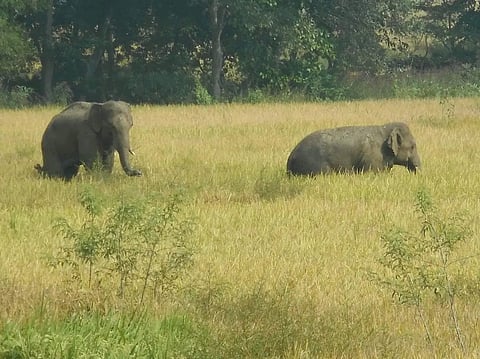


Jharkhand’s small and marginal farmers are facing large-scale crop and grain losses as elephants, nilgai, wild boars and monkeys raid fields and stored harvests.
In Latehar’s Katai Tola village, a herd of 14 to 15 elephants destroyed paddy stored in threshing grounds, wiping out months of work for tribal farming families.
State data shows Jharkhand records an average of 9,245 crop damage cases and 1,146 grain damage cases caused by elephants every year.
In just the last two-and-a-half months, elephants have killed at least 15 people across different parts of the state.
Farmers say compensation is too low, delayed and difficult to access, leaving many poor tribal families unable or unwilling to file claims.
Months of hard work disappeared in a single night for residents of Katai Tola, a tribal-dominated village in Jharkhand’s Latehar district. Surviving on small-scale farming and daily wage labour, they had finally found reason to celebrate this year after a good paddy harvest. They had also begun preparing for potato cultivation, hoping for a better season ahead.
But on the night of November 5, 2025, a herd of 14 to 15 elephants entered the village. They ate from at least 200 bundles of paddy stored in threshing grounds and then destroyed the rest.
For Arvind Oraon, a village resident, the elephants consumed 19 sacks of paddy stored in his threshing ground. Oraon regrets that because he returned late from the local market, he could not move the threshed and bagged paddy from the threshing ground to his house.
These are not large landowners who can recover easily. Forest department staff came, assessed the crop damage and left.
Ramkishun Oraon of Katai Tola said: “As evening falls, people remain confined inside their homes out of fear. Last October, elephants crushed Madhwa Oraon of this same village to death. They had trampled the paddy standing in his fields. Madhwa’s family is still waiting for compensation.”
Down To Earth (DTE) spoke with several affected farmers and assessed the ground situation. Almost every day, reports emerge from some part of Jharkhand of elephants killing people, destroying standing crops or damaging village residents’ homes.
Tribal regions surrounded by forests and plateaus remain the worst affected. Farmers say paddy and potatoes have become elephants’ favourite food.
Jharkhand, which has remained in the headlines over human-elephant conflict, is witnessing large-scale destruction of crops and stored grain by wild animals. The state has around 2.4 million small and marginal farmers.
Data shows that in Jharkhand over the past five years, an average of 9,245 crop damage cases and 1,146 grain damage cases caused by elephants have been recorded annually. Farmers say hundreds of incidents go unreported.
In just the last two-and-a-half months, elephants have killed at least 15 people across different parts of the state.
According to state forest department data, elephants killed 397 people during the four-year period between 2021 and March 2025. At the same time, the continuing deaths of elephants themselves tell another painful story.
Tribal-dominated districts including Khunti, West Singhbhum, Simdega, Gumla, East Singhbhum, Seraikela, Ranchi and Latehar, as well as parts of North Chotanagpur, have remained highly sensitive to elephant attacks and loss of life and property.
Currently, farmers in Seraikela, West Singhbhum, Khunti, Ranchi and Latehar are facing serious difficulties.
Between Sunday and Monday night, November 8, herds of elephants created havoc in Rania and Karra blocks of Khunti district. In Digri Dagutoli village of Rania, an Adivasi woman was trampled to death. Several farmers’ crops were also destroyed.
In remote areas of Rania block, village residents and farmers are troubled not only by elephants, but also by wild boars and monkeys.
In this context, thousands of men and women gathered at the Rania block headquarters on October 10. A large protest meeting was organised against what they described as the attitude of the forest department.
Suresh Kongadi, president of the Gram Pradhan Association of Rania block, told DTE: “People are losing their lives and their livelihoods are under threat. Tribals cannot abandon their homes and fields and move elsewhere. Forests and hills are our life.
“The forest department has remained indifferent regarding driving away elephants and protecting life and property. The compensation process is complicated and exhausting. Hundreds of poor tribals do not even file claims.”
Out of Jharkhand’s geographical area of 7.97 million hectares, 48 per cent is cultivable land and 31.51 per cent is forest area. The state has around 2.4 million small and marginal farmers, with an average holding of 1.74 hectares.
In 2024-25, the state produced 4.138 million tonnes of paddy. This year, production is estimated at 4.8 million tonnes.
Excess rainfall and changing monsoon patterns have negatively affected maize, pulses, oilseeds, ragi, sorghum and millet cultivation.
Amid questions over government procurement of paddy, the state government was set to begin procurement from 15 December.
On November 8, 2025, the cabinet approved an additional bonus of Rs 81 per 100 kg over the minimum support price. This means paddy will be procured at Rs 2,450 per 100 kg. An amount of Rs 486 million has been approved for this.
Ravi Ranjan, the state's Principal Chief Conservator of Forests (Wildlife), tells DTE, "A proposal is being prepared and submitted to the government to expedite compensation payments to affected families/farmers for losses caused by wild animal attacks. The process is being simplified. The compensation amount will also be increased. Clear instructions have already been given to officials to disburse pending compensation."
Latehar district is part of the Palamu division. Apart from Bariyatu block, areas such as Balumath and Herhanj blocks have also witnessed repeated elephant attacks, creating serious difficulties for rural populations.
On the night of November 3, 2025 a herd of elephants attacked Barikhap village in Salve panchayat of Bariyatu block.
Rajiv Bhagat, head of Salve panchayat, told DTE that elephants destroyed 200 bundles of paddy, around 4,000 kg, stored in his threshing ground.
In several neighbouring villages too, elephants consumed and destroyed paddy, potato and tomato crops.
He said that over the past three years, at least 40 compensation claims from his panchayat were submitted to the forest department, but only three people received payments. Receiving benefits under crop insurance schemes is also not easy, he added.
Shani Munda, a resident of the Panchpargana region of Ranchi district, said: “Half a hectare produces around 1,500 to 2,200 kg of paddy. If we sell this paddy at government procurement centres, we receive around Rs 45,000 to Rs 50,000.
“But if elephants destroy paddy cultivated in the same area, the forest department of the Jharkhand government compensates with a maximum of only around Rs 12,000 per half hectare.”
In the Palamu and northern Garhwa regions of the Palamu division, nilgai have become a major problem for farmers.
The region is known for maize, pulses, oilseeds and Rabi crops, but nilgai have destroyed cultivation for large numbers of farmers.
In the northern forest division area of Garhwa, including Bhawnathpur, Kandi, Meral and Garhwa blocks, nilgai destroyed crops spread across 268 hectares over the past three years.
According to forest department officials, 828 compensation applications were received, and Rs 7.36 million was paid as compensation.
Bhola Mehta, a farmer from Kandi who has been active as a farmer facilitator, told DTE: “Farming is no longer easy in this area. The number of nilgai is constantly increasing. They enter fields fearlessly at any time.
“They eat pigeon pea, potatoes, wheat, mustard, garlic and onion pods. To guard fields during the severe winter months of Paush and Magh, from mid-December to mid-February, people stay awake at night. Many farmers are now exhausted and have left land fallow.”
When asked about compensation, Mehta said: “There is a provision for compensation, but getting it is no less than a struggle. First inform the village head, then visit the circle office. Get land verification done. Submit an application to the forest department. Provide photographs of crop damage. Keep following government officials.
“How many places can a farmer run around? Often farmers fail to receive compensation because of paperwork errors or proof-related issues.”
Journalist Omprakash Pathak, who has covered ground issues in Garhwa for many years, said: “This area lies near the borders of Bihar and Chhattisgarh. The Son river floodplains are nearby, so nilgai easily get access to drinking water here.
“The forest department should work on a concrete plan for crop protection and simplify compensation procedures. A large section of the population here depends entirely on farming, and farmers are forced to endure repeated crop losses.”
Garhwa Forest Division Officer Anshuman told DTE that no official census has been conducted on the nilgai population in the Palamu region, but their number could exceed 1,000.
He said several plans had been prepared and sent to higher authorities to control the nilgai population and reduce crop damage. However, there were some obstacles in implementing them. Compensation is paid for loss of life and property.
This article is part of the series Conflict in the Backyard. A version of it was published in the cover story, Conflict in the Backyard, in the May 16-31, 2026 print issue of Down To Earth.