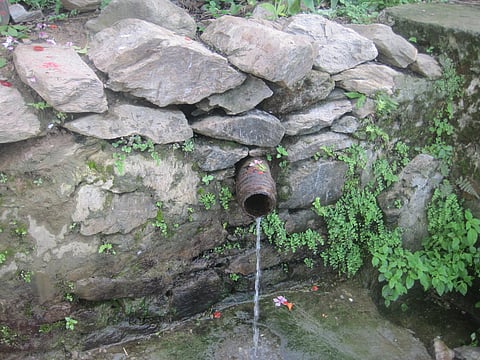


In Moldhar, a village in Uttarakhand, over 80 households once drew daily water from a single spring. Two years ago, that spring began to fail. Families abandoned agricultural land. Women spent hours sourcing fodder they could no longer grow. Then the village took action. Women, working with the International Centre for Integrated Mountain Development, dug over 700 water-collecting trenches in the springshed, established a community water user group, and revived the source using place-specific knowledge of local hydrology and land use. The spring came back. Each household now saves nearly Rs 10,000 a year in fodder costs alone.
No government ministry commissioned this. No climate fund paid for it. And unless India acts fast, no line in its forthcoming National Adaptation Plan (NAP) will acknowledge that it happened.
India is currently preparing its first-ever NAP, a document that will define the country’s adaptation priorities and unlock international finance through the Green Climate Fund. The Union Ministry of Environment, Forests and Climate Change leads the process across nine sectors. The government intends to submit the plan to the UNFCCC before the end of this year. This is a once-in-a-generation document, and it is, right now, at risk of repeating a very old mistake: measuring carbon while ignoring communities.
The water crisis in Uttarakhand is not a future projection. It is already unfolding. A 2018 NITI Aayog report found that nearly half of the estimated three million springs in the Indian Himalayan Region are either dry or drying. About 50 million people living across the 11 Himalayan states depend on these springs for drinking water, irrigation, and livestock. Yet for decades, India treated springs as invisible. Its national water policies of 1987, 2002, and 2012, despite their breadth, made no mention of springs, reflecting an institutional blind spot that persisted across three revisions and five decades. A meaningful shift came only in 2018 when NITI Aayog formally acknowledged spring depletion, yet even that report’s recommendations remain largely unimplemented.
The NAP presents India’s clearest opportunity to correct this. But the current consultation architecture does not support it. The nine ministries preparing sectoral inputs to the NAP carry no explicit mandate to document, codify, or integrate the indigenous and traditional ecological knowledge that Himalayan communities have developed over generations to manage water, land, and forest. The plan risks producing another technocratic document that counts emissions and targets infrastructure while the actual adaptive capacity of mountain communities goes unrecorded and unfunded.
This failure has a budget trail. The Union Budget 2025-26 did not mention the word “adaptation” even once in the finance minister’s speech. More telling still: the NAP, the Climate Change Action Plan, and the National Mission on Himalayan Studies — all instruments designed to fund exactly the kind of mountain resilience this article argues for — have received no budget allocation since 2022-23. India’s government preaches adaptation urgency while starving its own adaptation architecture of money. Meanwhile, the NAPCC, though formulated in 2008 and never revised, remains the primary framework. It includes a Himalayan Ecosystem Mission, but none of its eight missions explicitly integrated indigenous and traditional ecological knowledge as an adaptation resource. Uttarakhand’s State Action Plan on Climate Change, as DTE reported, did not even include a comprehensive vulnerability assessment.
The knowledge India needs is not absent. It is waiting. Uttarakhand’s communities have long maintained a vocabulary for water management that no ministry has an equivalent for. The Naula, a stone-lined structure that catches spring seepage, has sustained drinking water in Kumaon for generations. The Gul, a gravity-fed irrigation canal, requires no electricity. The Chal-Khal, a hilltop pond built to recharge groundwater, outperforms many engineered interventions in similar terrains. In April 2025, the Himmotthan Society mapped 10,063 springs across Tehri and Almora districts. It found 76 per cent showing declining discharge, and 86 per cent of surveyed households still depending on springs for drinking water at some point in the year, despite years of government water programmes. This data exists. It simply has no pathway into national policy.
Nor is this knowledge soft. A study published in Conservation Biology in April 2025 found that indigenous and local communities detect climate impacts on biodiversity with greater precision than conventional scientific monitoring. In Uttarakhand specifically, communities recorded phenological mismatches between plants and pollinators linked to shifting snowfall, changes that no remote-sensing dataset had captured. This is adaptive intelligence that satellite imagery cannot replicate.
India’s NAP now needs to make three structural corrections. It must carve out a dedicated sub-chapter on mountain ecosystem adaptation, with Uttarakhand and Himachal Pradesh as priority geographies. It must treat community-based spring mapping, already demonstrated as viable at scale by Himmotthan’s 2025 census, as a formal data input to the vulnerability assessments each ministry is currently preparing. And it must give the Gram Sabha a live institutional role in the NAP’s implementation architecture, not a consultative footnote.
Adaptation at scale will not be designed in Raisina Hill. It will be built by women in Moldhar who know which trench to dig, which hilltop holds water, and which season the spring runs dry. India’s NAP has a narrow window to capture that knowledge before the springs, and the institutional moment, dry up together.
Ankit Mishra is a Research Scholar in Political Science and ICSSR Doctoral Fellow at Govind Ballabh Pant Social Science Institute, Prayagraj. His research examines environmental politics, climate governance, and Indigenous Ecological Knowledge in the Indian Himalayan Region.
Views expressed are the author’s own and don’t necessarily reflect those of Down To Earth