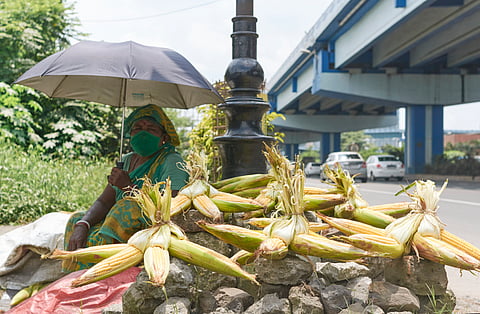


Nearly 8,500 women informal workers in Delhi and Faridabad will receive automatic payouts this summer if temperatures cross set heat thresholds.
Parametric insurance promises quick relief for workers losing wages to extreme heat, without a lengthy claims process.
But experts warn that temperature-based triggers may not capture the full impact of heat on health, work and income.
The model’s limits include patchy data, low payouts, difficult threshold design and the risk that workers continue labouring in unsafe heat.
On the hottest days, many workers face a brutal choice: earn and risk falling ill, or stay home and lose a day’s income. This summer, nearly 8,500 women in Delhi and Faridabad will be covered by an insurance experiment that promises quick relief — but deciding the price of heat is proving far more complicated than reading a thermometer.
Under the scheme, the informal women workers in urban areas will be part of an expanding national experiment to protect vulnerable workers from extreme heat. They will be covered by parametric insurance, which pays out automatically when temperatures cross certain thresholds. In this case, the trigger is between 45.27 degrees Celsius (°C) and 47°C.
Between May 1 and July 31, workers in the national capital, including construction labourers, home-based workers, and street vendors, will receive between Rs 100 and Rs 500 as insurance payouts for income lost due to high temperatures. The programme is being implemented by Mahila Housing Trust (MHT), a grassroots development group.
As Indian cities prepare for another summer of extreme heat, amid forecasts of a super El Niño, the MHT pilot is part of a wider shift towards parametric insurance among insurers, climate-risk groups and non-profit organisations.
India has between 400 million and 500 million informal workers, most of whom work outdoors or in poorly ventilated spaces. They have little or no financial cushion when extreme heat forces them to stop working.
Down To Earth (DTE) has reported how labourers are on the frontline of extreme heat, working in scorching temperatures at sites that lack climate control systems such as cooling or air conditioning, or where such systems cannot be used because of the nature of the work. For them, a heatwave is both an economic and a health emergency. Parametric insurance is being seen as one tool that can quickly put money in the hands of vulnerable workers.
Last year, DTE reported how India was experimenting with parametric insurance programmes to protect informal workers. Nagaland also became India’s first state to insure its entire area under the Disaster Risk Transfer Parametric Insurance Solution, with the aim of protecting infrastructure and reducing economic losses to people caused by disasters.
But experts caution that while parametric insurance can be useful as a quick-relief mechanism, it is not a long-term, stand-alone solution for a climate stressor as widespread and recurring as heat.
In the past two years, a few organisations have implemented parametric insurance schemes in states including Gujarat, Rajasthan and Maharashtra, with a focus on protecting vulnerable communities from extreme heat. They are MHT; HERA, a gender-focused climate adaptation non-profit; and VimoSewa, a multi-state cooperative. Community-centric non-profit Jan Sahas also piloted a parametric insurance programme last year.
This year, the experiment has reached Delhi and Faridabad for the first time.
In parametric insurance policies, the payout is triggered and determined by a pre-defined weather parameter reaching a specific threshold. This could be temperature in the case of a heatwave, rainfall in the case of flooding, or wind speed in the case of a cyclone.
This is different from traditional indemnity-based insurance, where payouts are made after lengthy damage assessments. The insurer decides the weather threshold with help from a risk assessment agency using a catastrophe model. This model draws on factors such as historical loss data from similar extreme weather events in the region, the policyholder’s capacity to manage risk and their exposure to an extreme event.
In Delhi, for example, three kinds of payouts have been decided on the basis of three temperature thresholds. If the temperature on a particular day reaches 45.27°C, the women will receive Rs 100. If it reaches 46.53°C, they will receive Rs 250.
If it reaches the third threshold of 47°C, they will receive Rs 500, said Bhavna Maheriya, programme manager at MHT. The overall payout, however, is capped at Rs 2,000 for the entire period.
In 2024, when Ahmedabad recorded temperatures of 43.7°C, its hottest day in eight years, 2,000 women construction workers and street vendors enrolled under MHT’s programme received an automatic payout of Rs 750 each, with no claims process.
In an earlier conversation with DTE, beneficiaries said they were initially surprised to learn that there was a scheme that could cover them against heat. For Ramilaben Jadhav, a 57-year-old construction worker who lost 20 days of work that May and June, the amount helped cover basic food expenses.
This year, MHT has added 4,000 more women to its parametric insurance programme, taking the total number to 30,800. The insurance will run for four months, from March to June. HERA has also covered about 225,000 women across 34 districts in India under its insurance programme.
The insurance premium costs about $8 per person. Each woman contributes about $3.5, while HERA covers the rest.
Forecasters have warned of one of the harshest summers in recent memory, with a Super El Niño expected to amplify the rapid warming already being experienced in large parts of the world. This has created a sense of urgency around scaling up programmes such as parametric insurance.
But the parametric model is also being promoted as a possible silver bullet. Experts said such insurance risks being portrayed as a stand-alone fix.
A complex financial instrument of this kind, newly being applied to heat, is not suitable for mitigating all the health and financial effects of recurring disasters, wrote Caroline Buckee, professor at the Harvard TH Chan School of Public Health, and Owen Gao, deputy director of the Extreme Heat Initiative at the Atlantic Council’s Climate Resilience Center, in a recent report on extreme heat. Titled Critical Perspectives on Extreme Heat in India, the report was published by the Salata Institute for Climate and Sustainability at Harvard University.
The model has clear limits. By anchoring payouts only to temperature, it overlooks the full complexity of heat exposure. Humidity, the nature and duration of work, the age of the worker and underlying health conditions all determine how severely heat affects a person, and how its impact changes when these conditions are considered.
For example, a 55-year-old construction worker labouring for eight hours in humid conditions may face a very different heat risk from a 35-year-old home-based worker. But the payout structure treats them in the same way, with no adjustment for humidity, physical exertion, age or pre-existing illness.
There is also a difference between temperatures recorded at weather stations and the heat experienced in congested, concrete and poorly ventilated neighbourhoods. If the temperature does not trigger an insurance payout, it does not necessarily mean workers have not lost income because of the heat they experienced.
Extreme heat is different from acute shocks such as flooding or cloudbursts, which are difficult to predict but easier to identify once they occur, said Sonali Gokhale, senior research associate at Prayas Energy Group. In such events, the damage is also easier to ascertain, which makes parametric insurance work better for that bundle of risks, she said.
“Extreme heat is expected to become a regular feature in the future. It is not expected to be an anomaly. There are many nuances to people’s experiences with heat in the context of the nature of work, outdoor or indoor, formal or informal, pre-existing health issues, gender, etc. There’s limited research on how extreme heat may impact exposed individuals,” Gokhale told DTE.
One of the biggest challenges in parametric insurance is setting the payout trigger, which depends on choosing the right data. But experts said that because of data gaps, meteorological thresholds are often poorly standardised or poorly linked to actual health or economic outcomes.
“Most research on heat exposure and human performance has focused on young men, often in military or athletic settings, and few studies have examined women, older adults, or workers in informal, low-income environments where heat exposure is most severe,” said the Harvard report.
The insurer decides the weather threshold with the help of a risk assessment agency, using a catastrophe model. The model is based on factors such as historical loss data from that kind of extreme weather event in the region, the policyholder’s ability to manage the risk, and their exposure to the extreme event.
In practice, any insurer would also want the insurance product to be commercially viable. If the threshold is set in a way that is triggered too easily, it may not benefit the insurer.
“There is an inherent tension in the design of a parametric insurance scheme for extreme heat given that a reasonable temperature trigger threshold may lead to multiple payouts in hotter weeks, which is good for the insured, however potentially raising concerns around financial feasibility for the insurance provider,” said Gokhale.
Gokhale and her colleagues examined a parametric insurance product offered by a private insurance company in India. The policy can be purchased digitally, and the premiums are determined by an algorithm developed by the company’s artificial intelligence (AI) technology partner.
According to the model, for a location in Pune, the payout threshold for April 2026 was set at 38°C. Their analysis of temperature data over the past 10 years showed that this threshold was crossed in six of those years. However, the number of days on which temperatures actually crossed the threshold in those six years was relatively low, at between two and four days.
Overall, the total annual payout, after accounting for the premium paid that year, would come to Rs 1,100 in a couple of years and Rs 100 in others. “These amounts appear insufficient to meaningfully offset the economic losses associated with extreme heat. Additionally, there would be four years in which premiums were paid but there were no payouts,” the analysis said.
The threshold has to be realistic, but that may not be viable for an insurance company because it could be triggered repeatedly during summer. Bhavna Maheriya said MHT has faced similar concerns in its experience with parametric insurance. She added it has not been easy for grassroots organisations to access accurate datasets for designing parametric insurance products.
For example, MHT’s insurance used the ERA5 global dataset by the European Centre for Medium-Range Weather Forecasts, or ECMWF, to calculate payouts. The dataset, which is available for free from 1940 onwards, is a reanalysis of global climate and weather over the past eight decades. Using this data, payouts were triggered for 2,000 women in Ahmedabad.
But if MHT had used India Meteorological Department (IMD), data, the payout would also have been triggered in two other cities, Surat and Rajkot. MHT compared the two datasets and found a difference of 3°C to 3.5°C. This year, they will use the IMD dataset for implementation.
“This was our learning. Unfortunately we cannot access and analyse the IMD dataset for continuous days for free,” Maheriya told DTE last year. In Gujarat, the model also required the temperature trigger to be crossed for two consecutive days.
“Our two years of experience there shows that when temperature triggers don't happen then women lose interest and their willingness to pay the premium. So, that is why we changed the two-day model for Delhi. We have changed things in Gujarat also this time. This year there are three thresholds, one has two consecutive days, the other two thresholds have single day payout,” she said.
But with the change in thresholds, the minimum payout has also been reduced from Rs 750 last year to Rs 100, as in Delhi. “Last year, the minimum payout was Rs 750. This time, we met with insurers and pushed for a lower trigger threshold so that the scheme could be activated more easily. The amount was reduced to ensure that a larger number of women would receive at least some support,” she said.
Prayas researchers suggest that the Insurance Regulatory and Development Authority of India should closely review how premiums are determined, especially for products targeting low-income workers.
One of the fundamental problems with the parametric model is that daily-wage workers must decide whether to stop working on a given day before knowing whether the payout conditions will be met, the authors of the Harvard report said. Forecasting uncertainties make this decision difficult, it said.
“Forecasting uncertainties, since heat waves are typically defined as a set of consecutive days above a temperature threshold, mean that workers are unlikely to forgo wages based on a forecast that might not trigger a payout. They may eventually benefit retrospectively from compensation, but few can afford to risk daily income in anticipation. Unlike other natural hazards such as floods or cyclones, work can continue under dangerously hot conditions, even when it is physiologically unsafe,” it stated.
The authors recommended that such insurance products should be used alongside heat-risk mitigation programmes. They also called for rapid and long-term infrastructure investments that safeguard health, and for other financial schemes that activate when workers’ health and livelihoods are at risk.
There should be empirical analysis and evidence-building before the model is scaled up, according to Gokhale. “There needs to be efforts towards conducting cost benefit analysis as to whether a parametric insurance scheme, under which either philanthropy or state governments, or grassroots organisations are contributing in the premium, is the best use of funds in order to have large scale beneficial impacts for public health for extreme heat,” she said.
Experts argued that there should be greater focus and investment in other initiatives, such as cool roofs and cooling centres, which organisations including MHT are already working on. They also said workers could be asked not to work for a few hours on days of extreme heat, with compensation provided for the income lost.