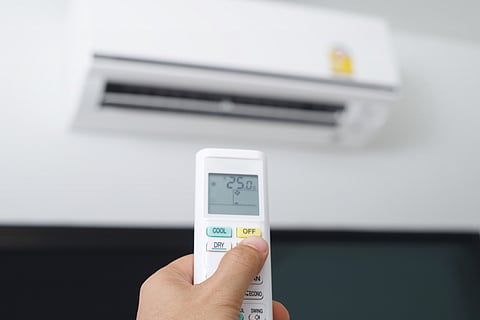


India could face power shortages within the next decade as rising air-conditioner use pushes cooling demand beyond the grid’s capacity, a new working paper warns.
Room ACs already account for 60-70GW, nearly a quarter of India’s peak electricity demand, according to the India Energy and Climate Center at UC Berkeley.
The report says India must more than double the pace of AC efficiency gains, from the historical rate of 2-3% a year to 6-8%, to manage future demand.
Without stricter efficiency standards, AC-driven peak demand could rise to 120GW by 2030 and 180GW by 2035, the study projects.
India is expected to add 130-150 million new ACs over the next decade as incomes rise and heatwaves intensify, the report says.
India could face severe power shortages within the next decade as rising air-conditioner use pushes cooling demand beyond the grid’s capacity, according to a new working paper by the India Energy and Climate Center at the University of California, Berkeley.
Room air conditioners already account for 60-70 gigawatts (GW), nearly a quarter of India’s peak electricity demand, the study found. Without stricter efficiency standards, AC-driven peak demand could surge to 120 GW by 2030 and 180 GW by 2035 — more than one-third of the country’s projected evening peak load.
India is adding 10-15 million new ACs every year and is expected to install another 130-150 million units over the next decade as rising incomes and intensifying heatwaves fuel cooling demand, the report said. The rapid growth in cooling demand is outpacing the grid’s ability to supply power after sunset, raising the risk of blackouts and expensive emergency measures unless efficiency improvements are accelerated.
To avoid future shortages, the report called for a sharp tightening of the country’s Minimum Energy Performance Standards (MEPS) for air conditioners. The proposed roadmap would increase annual AC efficiency gains to 6-8 per cent, more than double the historical rate of 2-3 per cent a year.
The report, titled Beating The Heat: How Air Conditioner Efficiency Standards Help India Avert Power Shortages And Cut Consumer Bills, said the move would also align India’s cooling-efficiency policies with its G20 commitment to double the pace of energy efficiency improvements.
“ACs are already contributing 60 to 70 GW to peak demand, and their growth is outpacing the grid’s ability to keep up after sunset,” said Nikit Abhyankar, lead author of the study and faculty member at the University of California, Berkeley. “Without intervention, we risk blackouts or costly emergency fixes. But with smart policy, we can turn this challenge into a win for consumers, manufacturers, and the grid.”
India could face peak power shortages as early as 2028, even after accounting for thermal, hydro, nuclear and storage projects currently under construction, the report projected. Under a scenario in which electricity demand grows by 6.5 per cent annually, the country could see an 8 GW evening peak shortfall by 2030, the study said.
However, accelerating energy efficiency standards for room ACs could almost entirely offset that risk, the researchers argued.
They recommended that India tighten its MEPS roadmap beyond the Bureau of Energy Efficiency’s already planned 2028 revision. The proposed pathway would raise the minimum Indian Seasonal Energy Efficiency Ratio, or ISEER, threshold to 4.3 in 2028, 5.3 by 2030 and 6.7 by 2033.
The 2033 threshold would be equivalent to the most efficient models already available in the Indian market, according to the study.
Sustained efficiency improvements could reduce AC-driven peak demand by 47 GW by 2035, according to the analysis. That reduction could help India avoid nearly Rs 8 lakh crore in generation and grid infrastructure investments by 2035, the report said. Annual electricity savings could reach 86 terawatt-hours by 2035, equivalent to the output of 45 GW of solar power capacity, according to the study.
Consumers could collectively save between Rs 91,000 crore and Rs 2.48 lakh crore over the lifetime of the appliances, even after accounting for the higher upfront cost of efficient units, the report estimated. The study also challenged the assumption that stricter efficiency standards would make ACs unaffordable.
Inflation-adjusted AC prices continued to decline in India, Japan and South Korea even as efficiency standards tightened, the researchers said. In India, room AC efficiency improved by 60 per cent between 2007 and 2023, while inflation-adjusted AC prices nearly halved, the study found.
“This is a chance for Indian manufacturers to lead,” said José Domínguez Bennett, co-author of the report and researcher at the India Energy and Climate Center. “With the right policy signal, they can scale under Make in India and PLI schemes, positioning India as a global hub for high-efficiency, low-cost ACs.”
More than 1,000 inverter AC models sold in India already exceed the current five-star efficiency threshold, indicating that domestic manufacturers and supply chains can support steeper efficiency targets, the paper said. Brands including Blue Star and Daikin already offer models with ISEER ratings above 6.0, according to the study.
Stronger efficiency standards could also bring climate benefits, the researchers said. Accelerated efficiency improvements could cut electricity-related emissions by 12 million tonnes of carbon dioxide annually by 2030 and 49 million tonnes annually by 2035, the study found.
India is at a critical turning point because urban AC ownership is still relatively low, at around 10-15 per cent, the authors said. “Every AC installed today locks in future electricity use,” Abhyankar said. “We have a narrow window to ensure they’re efficient. If we get this right, India can stay cool, avoid shortages, and lead the world in sustainable and affordable cooling,” he said.