

Cassava Brown Streak Disease threatens a staple crop relied on by millions across sub-Saharan Africa
Study warns more than a third of the continent is at risk of virus spread
Scientists urge stronger seed systems, surveillance and resistant varieties to prevent westward expansion
A viral disease that causes rot in cassava roots is threatening one of Africa’s most important staple crops, raising concerns for millions of people who rely on it for food and income.
Cassava, valued for its tolerance to drought and poor soils, acts as a safety net for families across sub-Saharan Africa. But researchers warn that Cassava Brown Streak Disease (CBSD) could undermine that resilience.
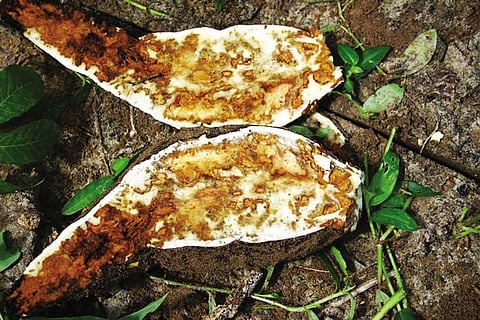
The disease causes necrosis in the roots of infected plants, often leading to total crop loss. Because the damage is sometimes only visible at harvest, farmers may not realise the scale of infection until it is too late.
A new study published in the East African Journal of Science, Technology and Innovation estimates that about 54.6 per cent of Africa’s landmass — roughly 16.2 million sq km — is currently suitable for cassava cultivation.
At the same time, researchers found that around 33.7 per cent of the continent — some 10.2 million sq km — is at risk of CBSD spread.
Although the virus is confined to Africa, it remained largely endemic for more than 70 years along the coastal regions of Tanzania and Mozambique. It has since spread to parts of Uganda and other areas in East and Central Africa.
Scientists now fear it could move further west into West Africa, home to major cassava producers such as Nigeria and Ghana, if control measures are not strengthened.
CBSD is primarily spread by the whitefly Bemisia tabaci, a pest that exists as a complex of genetically distinct groups.
The study’s lead author, Geofrey Sikazwe of Stellenbosch University in South Africa, says particular whitefly populations in sub-Saharan Africa, known as Sub-Saharan Africa 1 and 2, are highly efficient at transmitting the virus.
“They are present in huge population densities, particularly in East and Central Africa, driven by climate change and agricultural intensification,” he said.
Researchers say farming practices also contribute to the spread. Many smallholder farmers reuse cuttings from previous harvests as planting material, which can perpetuate infection if crops are already contaminated.
Formal clean seed systems in much of Africa remain weak, the researcher explained to Down To Earth. This contrasts with countries such as Thailand, the world’s largest cassava exporter, where certified disease-free planting material is distributed through more structured systems.
Adding to the problem, many high-yield cassava varieties developed to resist Cassava Mosaic Disease (CMD) were historically vulnerable to CBSD. “This created a vast reservoir of susceptible hosts,” according to Sikazwe.
German plant virologist Dr Samar Sheat, of the Plant Virus Department at the Leibniz Institute DSMZ, describes CBSD as one of the most serious threats to cassava because it can cause severe yield and quality losses.
Multiple research groups have used surveillance data and modelling to assess where cassava can thrive and where CBSD and its whitefly vector may spread.
“The highest current CBSD pressure remains concentrated in parts of East and Central Africa,” Dr Sheat said. “Westward risk is plausible where environmental suitability aligns with host availability and movement of infected planting material.”
She added that climate change plays a role, but is rarely the sole driver. Warmer temperatures and shifting rainfall patterns can influence cassava suitability and whitefly populations, increasing transmission risk in some regions.
However, she said the most immediate trigger of new outbreaks remains the movement of infected cuttings through informal trade and farmer-to-farmer exchanges.
Encouragingly, researchers have identified natural resistance to CBSD in South American cassava varieties. Germplasm from the region is being shared with breeding programmes in Africa and beyond.
Promising dual-resistant varieties are now under evaluation in countries including the Democratic Republic of Congo, Tanzania, Uganda, Mozambique, Malawi, Cameroon and Zambia, as well as Brazil and Vietnam.
“The broader goal is to develop varieties that can withstand multiple virus threats at once and still meet farmers’ needs and market preferences,” Sheat said.
Despite being in East Africa, Ethiopia remains one of the few countries in the region where CBSD has not been reported.
Abraham Woru Borku of Arba Minch University says field studies have not identified CBSD or its whitefly vector as a current threat to cassava production in southern Ethiopia.
Although whiteflies are present, they mainly affect other crops. Molecular studies suggest field spread of the virus through whiteflies is limited to around 17 metres per season.
“In Ethiopia, the main constraints on cassava are erratic rainfall and poor soils rather than CBSD,” he said.
Climate models suggest that rising temperatures could even expand areas suitable for cassava cultivation in drought-prone lowlands, positioning it as a potential climate adaptation crop compared with maize or sorghum.
Safeguarding cassava will require coordinated action. Recommended measures include improved phytosanitation, the introduction of virus-free planting material through tissue culture, and the development and distribution of resistant varieties.
Strengthening clean seed systems, building farmer surveillance networks for early detection, and managing whitefly populations through integrated pest management, such as intercropping and natural predators, are also seen as essential.
