

A Delhi-based white-collar worker swaps cars for a cycle to test if everyday commuting can help tackle the capital’s air crisis
Over four months, cycling proves as fast as motorised transport on congested city roads
The experience highlights both the feasibility of short-distance cycling and the structural gaps in urban infrastructure
Privilege, safety and gender remain key barriers to wider adoption
Long gone are the chilly winter mornings of years past. Delhi in winter is now better known for its poor air quality. At its worst, schools shut and work-from-home advisories are issued because the air turns toxic to the level of a full-blown public health emergency.
A significant portion of Delhi’s air pollution is localised. One could argue, therefore, that the solution lies with Delhiites themselves. While that’s not entirely true, collective public action must be part of the answer. Especially now, when air purifiers have become ubiquitous in homes and offices, and the government has floated tenders to install them in public schools and offices for mitigation, reflecting both urgency and helplessness.
In light of it all, an eccentric opinion seems a logical way forward. In a capital where the length of a motorcade reflects a politician’s stature, and the width of tyres and wheelbase of a car signal social standing, suggesting bicycles as a solution to a public health crisis seems almost absurd.
Yet, bicycles are everywhere in India. Nearly half of Indian households own one, although in Delhi the number drops to 27.2 per cent. With an average commute distance of just 4-6 kilometres, shifting towards cycling is not radical, but entirely feasible.
My workplace is about 7 km from where I live — a 14 km round trip each day. I already owned a 21-gear cycle, purchased during the COVID-19 pandemic and used for my commute back in my hometown. The transition to cycling in Delhi, therefore, felt natural. Over the past four months, I have cycled roughly 550 km, averaging 24-28 minutes per ride.
To put this in perspective, a cab or two-wheeler takes roughly the same time, with a variation of four to five minutes, as all vehicles use the same roads. My route has no dedicated cycling tracks, includes four intersections and six traffic signals, and overlaps with a heavily under-construction stretch of the Delhi Metro’s Phase IV, resulting in frequent diversions.
I added a simple strap-on glove box to the cycle to store my phone and essentials — a small but useful adaptation.
Traffic on major interconnecting roads is dense. This is worsened by parked cars — often occupying large parts of the road, legally or otherwise, which is a common feature across the capital.
In addition, lane discipline is almost non-existent. Buses, private vehicles, two-wheelers, autorickshaws and shared e-rickshaws all compete for space. Yet, somewhat surprisingly, vehicles often slow down to let cycles pass, creating a sense of safety. My commute coincides with office hours, when traffic is heavy and speeds are lower. This acts as a mitigating factor — but it is not a systemic safeguard.
I also recognise the privileges that make this possible. I am a male commuter. My work schedule is stable and predictable. My office provides dedicated cycle parking, creating a safety valve when parked for long periods of the work day. And I retain the option of switching to a cab when necessary. These are not universal conditions.
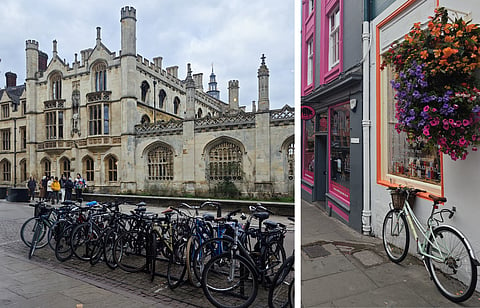
My time in Edinburgh and travels across the United Kingdom have inspired this experiment. Around Old College, at the intersection of North and South Bridge, cars and cycles coexist with relative ease. Not every street has dedicated cycling lanes, yet small interventions such as marked waiting spots for cycles at traffic signals make a tangible difference.
The role of cycles and cycling paths in cities like London and Paris in their remarkable improvement in air quality is now well established. Paris, in particular, under Mayor Anne Hidalgo, has achieved a 30 per cent reduction in fine particulate matter PM 2.5 levels, in part by adding more bike lanes. It is a well-known fact that building infrastructure to support pedestrians and cyclists is a more egalitarian approach to addressing traffic congestion, while simultaneously making cities safer.
An image from my travels to London has stayed with me: A cyclist braving the rain while commuting through the heart of the Westminster district, home to the Parliament. While travelling through the city and visiting a friend working as an attorney in London’s Magic Circle district, I observed white-collar workers e-biking to work, showcasing the mindset required to enable this shift. The clip of the outgoing Prime Minister of the Netherlands, Mark Rutte, cycling home after leaving office is a powerful symbol of the social change that such a shift in mindset can eventually bring about.
Infrastructure development in India has always followed public need. Yet, the current urban mobility system places the interests of car manufacturers at its core. The development of car-only coastal roads in Mumbai and the construction of multiple ring roads within cities are prime examples. A shift in the commuting mindset of white-collar workers can help drive meaningful change, reducing emissions and saving cities from drowning in toxic smog.