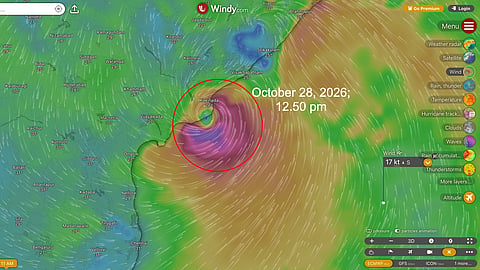


Cyclone Arnab threatens Andhra Pradesh with heavy rainfall and winds gusting up to 140 km/h.
Odisha, Chhattisgarh and Telangana also face heavy rainfall and thunderstorms.
Visakhapatnam recorded 220 mm of rainfall in 24 hours, according to the weather report.
A western disturbance could bring rain, hailstorms and Himalayan snowfall to northern India.
Cyclone Arnab was approaching the Andhra Pradesh coast on October 28, 2026, threatening heavy rainfall, strong winds and flooding across parts of southern and eastern India.
The cyclone's impact could extend beyond Andhra Pradesh, with Odisha and Chhattisgarh also expected to receive heavy to extremely heavy rainfall, raising the risk of waterlogging, flash floods and disruption to daily life.
Some areas could receive more than 204.5mm of rain in 24 hours, with red and orange weather alerts possible in affected districts. Coastal and low-lying settlements are particularly vulnerable to flooding.
Telangana and Vidarbha could receive heavy to very heavy rainfall of 115.6–204.4mm, while Jharkhand, West Bengal, eastern Madhya Pradesh, Assam, Meghalaya and other northeastern states may also experience heavy showers.
Strong winds of 60–70km/h are forecast in parts of Odisha and Chhattisgarh, with thunderstorms possible in Telangana and Jharkhand.
Rainfall figures cited in the weather report show that Visakhapatnam received 220 mm of rain over the preceding 24 hours, while Kalingapatnam recorded 150 mm.
Kakinada and Tuni each received around 120 mm, while Machilipatnam recorded 110 mm.
In Odisha, Gopalpur received 90 mm and Puri recorded 70 mm.
Such intense rainfall over a short period can overwhelm drainage systems, flood roads and agricultural land, and disrupt road and rail transport.
Meanwhile, a separate western disturbance, accompanied by an upper-air circulation, could bring rain and thunderstorms to Jammu and Kashmir, Himachal Pradesh, Uttarakhand, Punjab, Haryana, Delhi and neighbouring areas between October 28 and 30.
Higher reaches of the Himalayan states could receive snowfall, potentially disrupting travel along mountain roads.
Hailstorms are also possible in parts of Haryana, Chandigarh, Delhi and Punjab on October 29 and 30, posing risks to standing crops and outdoor activities.
Temperatures continued to vary sharply across the country.
Rajkot in Gujarat recorded a maximum temperature of 39.3°C on October 27, while Mandi in Himachal Pradesh registered a minimum of 10.9°C, according to figures cited in the weather report.
