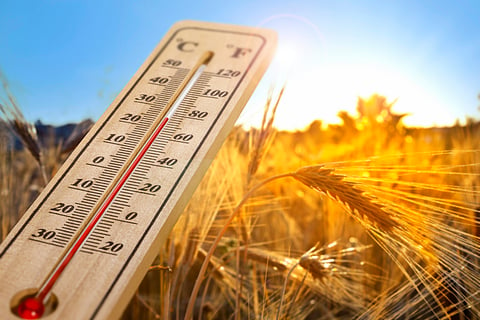


A joint FAO-WMO report warns that extreme heat is rapidly becoming one of the biggest threats to global food production.
Temperatures above 30C are already reducing yields of major crops including maize, wheat and soybean, while also affecting livestock, fisheries and farm workers.
India is among the countries facing growing risks, with rice production and agricultural labour increasingly exposed to dangerous heat stress.
The report says agricultural losses can triple when heat combines with other hazards such as drought, making adaptation and emissions cuts critical for food security.
Extreme heat is rapidly becoming one of the biggest threats to global food production, putting crops, livestock, fisheries and the livelihoods of billions of people at risk, according to a joint report by the Food and Agriculture Organization (FAO) and the World Meteorological Organization (WMO).
The report, released in April 2026, says temperatures above 30 degrees Celsius (°C) are already reducing yields of major crops, while rising heat is threatening farm workers, livestock, fisheries, forests and agricultural incomes.
It comes as large parts of Europe, North America, Asia and the Middle East face intense heatwaves, with scientists warning that climate change is making heatwaves more frequent, longer lasting and more severe.
The report describes rising temperatures as a “risk multiplier” for agriculture, worsening droughts, increasing wildfire risks and triggering wider disruptions across food systems. “The fingerprints of extreme heat on agriculture are already visible worldwide,” it says, based on a review of global scientific evidence and case studies.
Most major food crops begin to suffer yield losses once temperatures exceed 30°C, the report says. It estimates that maize yields have already declined by 7.5 per cent for every 1°C of warming, wheat by 6 per cent and soybean by 6.8 per cent.
Looking ahead, maize and wheat yields could fall by up to another 10 per cent for every additional degree Celsius of warming, the report warns.
Heat-related declines in agricultural productivity are already reshaping land use. Between 1992 and 2020, about 88 million additional hectares were brought under cultivation across 110 countries to compensate for production losses caused by heat and related stresses, including drought.
The report says this expansion generated an estimated 21.8 billion tonnes of carbon dioxide equivalent emissions, or 18.9 per cent of total land-use emissions in those countries. This creates a damaging cycle: climate change reduces farm productivity, more land is cultivated to maintain output, land-use emissions rise, and climate change worsens further.
Rising temperatures are also affecting the combined productivity of land, labour and capital in farming. Since 1961, heat stress has reduced global agricultural productivity by about 21 per cent, wiping out nearly seven years of productivity gains, the report says
India is among the countries facing growing risks from heat stress in agriculture. Citing research on rice cultivation in India, the FAO-WMO report says more frequent and intense heatwaves are making the crop increasingly vulnerable. Farmers are adapting by using early-flowering and heat-tolerant rice varieties, changing sowing dates and relying on irrigation to cool land surfaces.
But the report warns that these measures may not be enough. Rice cultivation in India depends heavily on manual labour, leaving farm workers exposed to dangerous heat in fields. A recent UK-based analysis cited in the report found that Indian agricultural workers lost an average of 648 working hours, equivalent to 54 full working days, to heat stress in 2024.
The report says that under high-emission scenarios, parts of the Ganga and Indus river basins could experience wet-bulb temperatures that approach or exceed safe limits for outdoor work by the end of the century. Without stronger action to cut emissions, heatwaves could become a major threat to both Indian agricultural workers and rice production, it warns.
The report also says prolonged exposure to extreme heat is becoming a serious occupational hazard. Some regions could experience up to 250 days a year when outdoor agricultural work may become physically unsafe.
The report says there is little evidence that grain production has become more resilient to extreme heat over the past 50 years. Globally, crops such as maize, soybean and wheat remain almost as vulnerable to temperatures above 30°C as they were decades ago, although impacts vary by region.
In some countries, including Brazil, crops have become even more sensitive to extreme heat, the report says. This has major implications for food security, particularly in regions where agriculture is already exposed to drought, water stress and high labour dependence.
Livestock are also increasingly vulnerable to extreme heat.The report says cattle, goats and sheep begin to experience heat stress at temperatures above 25°C, while pigs and chickens are affected above 24°C. For every 1°C rise above 30°C, livestock reduce their feed intake by 3 per cent to 5 per cent, leading to lower milk and egg production, weight loss and poorer health.
Milk yields in dairy cattle decline by about 2 per cent with each additional unit of heat stress, while pigs are among the most vulnerable animals because they cannot sweat to cool themselves. Prolonged heat also weakens immunity, reduces fertility, increases disease and mortality, and lowers the quality of milk, meat, eggs and wool.
Under a high-emissions scenario, in which emissions roughly double by 2050, nearly half of the world’s cattle could be exposed to dangerous heat by the end of the century. Annual losses in cattle meat and milk production could approach $40 billion, the report warns.
Under a low-emissions pathway, those losses could be reduced by nearly two-thirds, showing the benefits of limiting global warming.
The report also highlights the growing impact of extreme heat on fisheries, orchards and forests. Marine heatwaves have already caused repeated mass mortality events and forced fish stocks to move towards cooler waters, disrupting fisheries and coastal livelihoods.
Fruit and nut orchards, as well as forests, are becoming more vulnerable to heat-related production losses and more frequent and intense wildfires. The report says extreme heat and other climate stresses are already reducing food production and incomes in agrifood systems that support about 1.23 billion people.
Agricultural losses can triple when heat coincides with other hazards such as drought, it adds.
This is particularly relevant for India, where drought has spread sharply in recent weeks. As of July 1, 2026, 41.2 per cent of the country’s area was under drought or near-drought conditions, up from 19.6 per cent a month earlier.
The FAO-WMO report calls for urgent investment in climate adaptation to protect food systems. It recommends improved early warning systems, climate information services, heat-resilient crop varieties, revised planting calendars, better water management and financial protection for vulnerable farming communities.
But the report cautions that adaptation will not be enough on its own. With global temperatures nearing the Paris Agreement’s 1.5°C warming threshold, it says ambitious efforts to reduce greenhouse gas emissions remain essential to protect agriculture and food security from escalating heat.
Without faster emissions cuts, the risks to farmers, food production and rural livelihoods will continue to grow.
