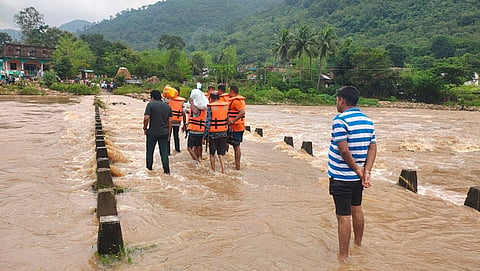


A third cyclone could strike Andhra Pradesh within a month, as coastal communities struggle to recover from two successive storms.
Being an unprecedented El Niño year, the post-monsoon season of 2026 can throw up surprises in cyclogenesis.
Experts warn that India must strengthen long-term disaster resilience, including infrastructure, healthcare and emergency communication systems.
There is a possibility of a third cyclone striking the eastern coast of India, particularly Andhra Pradesh, within a month. The governments of Andhra Pradesh, Tamil Nadu, Odisha and other potentially affected states have to consider the long-term impacts of repeated cyclonic storms for costal communities, particularly the loss of livelihoods and damage to public infrastructure.
The India Meteorological Department (IMD) in its tropical weather outlook on November 11 indicated the presence of an upper air cyclonic circulation over the south Andaman Sea. The weather agency forecast the formation of a low-pressure area over the region on November 13.
The system could then move northwestwards and intensify into a well-marked low-pressure area on November 14, followed by a depression on November 15. The IMD has not indicated whether the depression will intensify further, but the forecast could change as the formation of the low-pressure area occurs.
Data from the European Centre for Medium-Range Weather Forecasts (ECMWF), visualised on the weather analysis platform windy.com on November 11, however, suggests that a cyclone could form around November 16 and move towards the southern Andhra Pradesh coast by November 19.
If the cyclone forms and moves towards the Andhra Pradesh coast, it would be the third cyclone landfall in the region within a month.
Two storms, widespread losses
The first storm, very severe cyclone Arnab, made landfall along the Andhra Pradesh coast in the early hours of October 28. A second low-pressure system made landfall further north, along the southern Odisha coast that evening. The second storm, severe cyclone Murasu, made landfall along the southern Andhra Pradesh coast on the intervening night of November 2-3.
Together, the two cyclones damaged crops across 461,000 hectares in Andhra Pradesh, according to media reports. Horticultural crops were damaged across 29,960 hectares. Recovery is still under way in Andhra Pradesh, as well as parts of Odisha and Tamil Nadu. A third cyclone could compound their difficulties, especially by reducing the number of days people can work and earn a living.
"In 2013, the post-monsoon season produced four cyclones—Phailin, Helen, Lehar and Madi. In that sense, it is only the third cyclone potentially,” K J Ramesh, former director general of IMD, told Down To Earth (DTE). He warned that “being an unprecedented El Niño year, the post monsoon season of 2026 can throw up surprises in cyclogenesis”, he added.
Long-term disaster management and resilience planning are therefore essential but remain inadequate in many parts of India.
Resilience must go beyond cyclone shelters
“Taking people out of their homes and relocating them to cyclone shelters is a good way to save lives but that disrupts the local economy so we will also have to think about disaster resilience in the long term,” Sanjay Srivastava, principal scientist at Climate Resilient Observing Systems Promotion Council (CROPC) and convener of the National Lightning Resilient India Campaign, told DTE.
“Disaster resilience in the long term would mean construction of climate-resilient infrastructure which would permit the economy to function to an extent even in the immediate aftermath of a disaster,” said Srivastava. He highlighted the construction of elevated corridor of roads in coastal areas and underground electric power lines as steps that could be taken, apart from changes in housing patterns in the vulnerable regions.
Srivastava also pointed out the inadequacy of district-level emergency centres, particularly the shortage of experts available to advise on minimising losses and addressing the societal concerns during a disaster. “The region where the third cyclone could strike is already suffering from swollen rivers and saturated soils and the cropping cycle has already been affected but plans to support farmers in such times is still not up to the mark,” said Srivastava.
Another urgent preparedness measure would be to ensure the last-mile delivery of essential healthcare, food and nutrition services in affected areas. Preventive healthcare measures are crucial in such times, according to Srivastava.
Emergency communications could also be strengthened by establishing local amateur radio (HAM) networks in every gram panchayat. Cyclones and other disasters often cause widespread disruptions to telecommunications, making alternative communication systems essential.