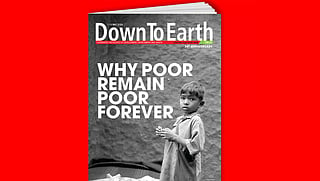
Highlights from the issue

Highlights from the issue

Subscribe today for full access to our journalism that combines scientific rigour with passion
Listen to this article

Sunita Narain's Desk: A steady voice in the age of noise

A steady voice in the age of noise
Illustration: Ritika Bohra/CSE

As Down To Earth enters its 35th year of publication, I want to make one thing clear: we are neither for nor against any government. We stand firmly for development that is inclusive, and therefore sustainable

Cover story: Poverty's own republic

India’s geography of poverty does not change. To be born here means to be poor forever

Poverty's own republic: "With birth, poverty is certain here"

Poverty’s own republic: “With birth, poverty is certain here”
Sangu Ram, resident of Kauhabahra village in Chhattisgarh’s Dhamtari district, has lived in poverty and hunger all his life. His children are also officially classified as extremely poor and are deemed at risk from hunger(Photograph: Purusottam Singh Thakur)

100 droughts, 10 famines, 10,000 deaths: "I am a sukhbasi"   

Poverty’s own republic: “100 droughts, 10 famines, 10,000 deaths”
Lakmu Salam, from the Abujhmad area of Chhattisgarh, says poverty will not leave him or his next generation (Photograph: Purusottam Singh Thakur)

Third hereditary burden: "Deep inside jungles, nobody can find us"

Poverty’s own republic: “Deep inside jungles, nobody can find us”
Residents of Chinddi village in Chhattisgarh’s Gariaband district show the container they use to collect grain in exchange for labour(Photograph: Purusottam Singh Thakur)

Rich land, poor people: “Our old world was a free economy of forests”

Poverty’s own republic: “Our old world was a free economy of forests”
Over half of India’s population has no significant wealth at all. There are clear signs that those left behind in the “great wealth rush” may struggle to catch up, and remain stuck in the cycle of poverty(Photograph: Richard Mahapatra / CSE)

In an unequal world: "Who is poor"

Poverty’s own republic: “Who is poor”
In Dangabanji village in Odisha’s Balangir district, most residents have mortgaged themselves for years. The village keeps a unique register (inset) recording details of the migrant residents and advances taken from labour contractors(Photograph: Richard Mahapatra / CSE)

Appraisal: Return of the industrial strike

Police detain a man in Noida, Uttar Pradesh, on April 14 while patrolling a neighbourhood after protests by factory workers for higher wages
Police detain a man in Noida, Uttar Pradesh, on April 14 while patrolling a neighbourhood after protests by factory workers for higher wages(Photo: Reuters)

The labour unrest in north India’s industrial belt points to deeper shifts: weaker job creation, stagnant pay and a more unequal growth path

Civil lines: India’s first energy exodus

India's first energy exodus
Photo for representation.Photo: iStock

It is an unprecedented situation in which energy-related distress triggered reverse migration

Special report: Perpetual heat

Extreme weather events during pre- and post-monsoon months are the new threat to hit farmers across India

Special report: El Niño meets warming

El Niño meets warming
The most immediate impacts of a super El Niño could be land and marine heatwaves, droughts, wildfires in some regions; and extreme rainfall, storms and floods in others(Photograph: istockphoto.com)

Forecast of a “super” El Niño, the strongest in a century, in the latter half of 2026 raises concerns of adverse climatological impacts in a world already reeling from accelerated warming

Special report: Weak monsoon ahead?

Super El Niño impact: Will India see a weak monsoon
Photo: iStock

India may see below normal rainfall in the upcoming southwest monsoon, with immediate impacts for farmers

Science: A gene hurdle

A gene hurdle
Illustration: Yogendra Anand / CSE

International Olympic Committee's new genetic-testing mandate for athletes in the female category fails the test of fairness

Science: Altered carbon

Rising trend of CO2 in human blood parallel to atmospheric rise, altering blood chemistry 
We may have already entered a period where there is permanent and developing physiological compensation for CO2 in our bodies. Photo for representation. iStock

Rise in atmospheric carbon dioxide levels is altering blood chemistry; this not just impacts human physiology, but also has potential for future genetic priming

Patently Absurd: A fixation on the past that’s stunting Indian science

A fixation on the past that’s stunting Indian science
Illustration: Yogendra Anand / CSE

Forcing premier technology institutes to do research on ancient wisdom is fostering fraudulent science and retarding development

Book review: A taste of the terrain

A taste of the terrain
Illustration: Yogendra Anand /CSE

A cookbook of Kargili dishes, a coffee-table book of intimate portraits, or a book of anecdotes from across the region—Stories from a Kargili Kitchen offers something to every kind of reader

Down To Earth
www.downtoearth.org.in